
 Posts
Posts



January 2012
Dear friends,
Getting ready for Vintage Weekend at Ocean Reef was a repeat of last year, with the same results: Last minute preparations gone awry. Not a cloud in the sky but as soon as Bernard Smith put down his brush, finished with painting the deck, a cloud slid over the boat and it rained. Since this was again at the last minute, there was no time for a re-do. I had to laugh – through gnashed teeth.
This year was a first for me, I backed Aurora II in the slip like pro. Having never done it before with Aurora, it would have been embarrassing had I messed up at Ocean Reef. I don’t know if it was luck or Vicki Goldstein’s magic but we ended up docked for the show next to Cindy and Buddy Purcell of Huckins Yacht Corporation. We have known each other for years. Before Aurora’s lines were cleated, Buddy and I struck up a conversation. I recently read something that was interesting and blurted it out to Buddy. “I just heard that cold molding was invented in the 1970s? Is that true?”
Cindy joined the conversation then to set the record straight. Cindy is the granddaughter of Frank Pembroke Huckins and boatbuilding is in her blood. She said, “I’ve heard that too but my grandfather was building cold-molded boats in WWII but they called it plywooding.”
Then she handed me this beautiful book, “Huckins, The Living Legacy.” I didn’t know it at the time, but she was giving me the book to keep. It’s an incredible book and the more I read, the more I wanted to read. So let me share some of what I found out about cold molding.
Franklin Pembroke Huckins started building boats in the 1920s. His boats were fast and had a very distinct style. By the time that WWII was in full swing, the government wanted smaller, faster and disposable boats for the war effort. Frank jumped in feet first, crashing the party. Navy didn’t invite Garwood either.
Elco and Higgins built most of the PT boats, but Huckins produced 18 of them. The Huckins-built PT boats were known in the Navy as “the yachts,” and sailors who served on them were ribbed for having it easy from the guys getting their brains pounded on the lesser PT boats.
In July 1941, there was a plywood derby. The Navy was ready to pull the plug on the PT boats because of myriad problems. In particular, the boats were tearing themselves into pieces as well as beating up the crew on them. So when Frank Huckin’s prototype, PT 69, turned faster, took rougher seas and outperformed the competition, the Quadraconic Hull design, a hull that planed without the pounding, proved superior. Huckins also introduced diagonal planking so he was quite the boatbuilding innovator.
Henry Baldwin, Huckin’s partner and corporate CEO, negotiated for the hull design royalties, which didn’t turn out too well since Elco adopted the design and produced most of the PT boats. Huckins didn’t see a cent from others co-opting the design under the Navy’s direction.
The process of plywooding was simple. Laminate mahogany boards at 90 degree angles and glue together with resorcinol glue, a form of formaldehyde-based glue. It was tough stuff and it still is today.
The term cold-molding was used at Huckins until 1976 then they moved to Airex core construction. So how much did Frank Huckins make on his first PT 69? It cost him $115,000 to build in the 1940s and his profit was $28.60. I am sure he did a little better on the next one but that was a gutsy gamble. And his Quadraconic hull design still is as great today as it was in 1941.
So as we sat on the back deck of Aurora II, sipping wine and swapping boatbuilding stories with the Purcells, Nate and I couldn’t be happier sharing our passion for wooden boats.
We spent a lot of time together that weekend and when it was getting time to leave, Stephanie told me to make sure we returned the book. Cindy said it was ours, to keep it. As I had more time to look through the book, I realized it was a limited edition, 2,917 out 3,000. The Huckins book has an honored place on Aurora II. While you can’t have mine, they are available on Amazon.
There was a nice mix of boats at Vintage Weekend: “Stringray,” a Ray Hunt design; the Trumpy “Bernadette,” the former Litchfield Lady, fresh out of a major refit and the Trumpy “Washingtonian,” now in charter at the club.
This year was the year of the Burgers, with 17 of them at the show from different eras of various styles.
Leaving Ocean Reef, and heading north into 25 to 35 knot winds, we reached Biscayne Bay with its short steep chop. Aurora’s bow plowed through them sending spray all the way over the top deck and the smokestack, washing away the sparkling weekend. When we reached the Intracoastal, it was hard to see out of the salt-crusted window. We washed the pilothouse windows and quietly motored on home, back to our regular routine.
December is not my favorite month. Everyone wants their boat finished and there’s so much to do with shopping, parties, and more shopping. We launched “Dune” in time for the holidays and the owner, Simon Decker, and I go way back. We did a major structural rebuild on Dune in 2000. Simon, back then, was a man of the world, traveling everywhere from Tanzania to Paris to Switzerland to Argentina. He is fluent in a half-dozen languages. He’s cut back on his traveling now that he has a family, but Simon still leaves the country more times in a year than many people do in a lifetime.
We started on “Dune” with a few small projects, based on a highly regarded surveyors’ report. There turned out to be major problems and Dune became a major project. Back in those days, cutting-edge technology was a Sony digital camera that used floppy disks. I would make 15- second movies and send them to Simon around the world. This year, Simon told me what he really thought of my little movies: He was appalled and horrified.
New to wooden boats, Simon thought the boat needed a little wood work here and there, and I was showing him giant holes in the side of the hull. He felt he was being taken advantage. Meanwhile, I was having nightmares about the boat sinking off the coast of Africa, where he initially planned to take her. I was trying to figure out how to solve her problems and make her stronger, within a budget. There was a lot of communication barriers back then since we went through representatives.
Since that time, Simon has taken Dune everywhere, to the Caribbean Islands and back. Somewhere along the line, he realized of all the work that Dune has had in the decade he has owned her, the work we did was in fact looking out for the best interest of him, his family and the boat.
As we stood on the dock, Simon said, “You are the only one looking after Dune now.” That capped the year for me. I try not to take things personally, but I do. Sometimes, it even tears me up. And Dune was one of those projects.
Simon put one motor in forward and one in reverse and hit the bow thruster switch and Dune glided away from the dock and then was gone, back to her berth in Coconut Grove.
Then we helped Frederic Marq on Cora Marie launch his 107’ Ted Geary design. We just helped him with some minor worm damage and caulking, and showed his guys how to putty and paint the bottom properly.
My next story I hope you will find funny although it’s at my own expense. Sometimes, the best laid plans can have a glitch or two. James and I planned on taking Aurora II on an adventure during the holiday break. All I had to do was haul out, block and laser target a 60 foot Trumpy then off we would go.
As these things typically do, it took a little longer than expected. We finally got off the dock and headed north. With the days being shorter this time of year, we passed Jupiter and I knew we would just make Peck’s Lake before darkness. Arriving 20 minutes before sunset we set anchor between a bunch of sailboats. As the hook set, the guy anchored beside me said he had 90 feet of anchor rode out. I replied, “Thirty foot sailboat in six feet of water. Don’t you think that’s a little much!” Anyway, we moved and then moved again.
Finally, just as the sun set, we were finally hooked and watch a movie. Then the moon and stars came out and we went to bed. About 1 o’clock in the morning, I heard little waves lapping the hull. So I went up on the deck. Aurora was softly setting aground, with James sleeping soundly. I pulled at the anchor and it was bit. So I thought to myself we will be off in the morning. But then I didn’t check when low tide was. I didn’t figure the tide still had three feet to drop. I went back down below and went to sleep.
By 3 a.m., all the furniture in the pilothouse had shifted or skidded on tables, books had fallen, fresh fruit had floated from one side of the galley to the owner’s stateroom. James called out, “Dad, there’s water in my bunk.” Aurora was heeled over like a racing sailboat on a windy day. We pumped the water out. When the tide came up, I swallowed my pride and call Towboat to pull us free. My son said, “Why didn’t you wake me, and we could have …”
I didn’t have the heart to tell him that hindsight is 20-20.
“I promised you an adventure you would never forget.” With the seriousness only a 13-year-old boy can muster, James replied, “I will never forget this!”
Oh, his laptop took a swim as well as his mom’s Ipad. Thankfully, Stephanie was in a good mood visiting Koreatown in L.A. where she had just come out of a day spa. She had just been steamed, baked, boiled and scrubbed like a dirty Irish potato, Stephanie said. For Koreans, even relaxation can be grueling.
After Towboat let our lines loose and pulled away, we were on our way as well. The engines hummed, and Peck’s Lake slid from view as we continued on our journey. Our adventure was just beginning. James won’t be 13 again and I don’t know how much more time he’ll want to spend with his old dad. I thought to myself, “ I’ll remember this trip, too.”
Until next time,
Jim Moores
Tuesday, June 19, 2012
April 2012
April 2012
Dear friends,
Yesterday was one of those great days that come every so often. It started by putting the last-minute touches on Sirius. The proof is in the pudding, don’t know where that expression comes from but it’s true. With the push of the starter buttons, the 871 roared alive. Capt. Dave Culver nodded his head and the gang way came aboard, the lines were tossed and just when Sirius started to move forward, my partner Stephanie Smith yelled “Wait!” It was perfect timing. Dave nudged Sirius back towards the dock and we gave Stephanie a strong hand aboard. Our guys were checking the shafts and yelled up “Okay,” just as we cleared the Rybovich channel.
There waiting to come into the slip the Sirius just left was Capt. Ted Schmidt on the Trumpy “America.” Unfortunately, I couldn’t get a picture when the bows of two great Trumpy yachts crossed paths since I was on one of them but these are moments I will always remember.
Capt. Dave slowly notched up the throttles. The purr of the motor made you feel Sirius coming back alive after a long sleep. All the hard work was done. This was Devin Lloyd’s first project as lead carpenter and you could see the sense of accomplishment on his face. Devin is a Florida boy, grew up on these waters boating, fishing and surfing.
I have been asked many times through the years why we restore old wooden boats and yachts when there aren’t that many of them left. The answer was written on Devin’s face: Satisfaction. We headed out the inlet. The sea was calm with a slight roll. A bright sun on clear blue-green waters, it was a great day. When we made it back, it was like Trumpy Central with four of them tied to the dock. There was my boat Aurora II as well as Liberty, Sirius and America. This doesn’t happen often enough and that made the day particularly one I’ll remember.
After all of us got off after the sea trial, Capt. Dave and Pam Culver slid the lines aboard again and Sirius gracefully slipped away from the dock and then she was gone.
Sirius’ new home will be Grand Rapids, Michigan and Dave and Pam will be heading north later this spring.
Back at the shop, the 40’ Garwood was ready to come out of the paint shed. We work on this sleek beauty every year with minor touch ups but this year our painter Bernard Smith put two coats of Dupont MS-1 clear everywhere and it was just magic. She gleams and with twin 550 HP engines, she flies as well.
When I got back to my desk to check on emails, there was one from Nate Smith at Moores Marine Yacht Center in North Carolina. There she was, “Pilar” on a mobile boat mover being transported from the carpentry shop to the paint shed, see photo. Any one of these events would have made my day. Happening all at once made it particularly special.
Next, summer is almost here which means it’s time to think about what James, my youngest son, is going do. Camp, camp and more camp.
First, there’s Boys Scout camp then Chapman School of Seamanship then off he goes to North Carolina for the state maritime museum’s sailing camp, where James has a chance to be a junior sailing instructor this year. Then he will work with his Uncle Nate at our boat yard.
I want to foster in James my love of wooden boats and the water. About a month or so ago, I was thumbing through a magazine when I stopped on an advertisement. There was a beautiful varnish model sailboat with a website, www.modelsailboat.com. Within seconds there I was watching these boats sail in a video online. I ordered the T37. The gamble was would James be interested in building a wooden boat? Just because I like something, would he? When he showed no interest I took the book to the boat. “James, we will read the book together.”
The next day, we started to read. Then we put the hull together. James built the rudder and bent the rudder shaft in a vise. It fit. Yesterday, with all that was going on, I wasn’t able to help him. But at the end of the day, James started telling me that he had glued the rudder post in and resin saturated the bottom. There is a spark in his eyes and a tone in his voice. Someone recently told me it’s not how much you know that makes a great teacher. It’s how much you inspire someone to learn. James has already picked out a name for his boat, “Scout.” We are already talking about the next boat and we haven’t finished this one. We will see.
One last story. As I was driving to work today I got a call from Marty Isenberg. He was driving to work too. I had forwarded photos of Pilar, Nate Smith’s project in MMYC, on to him and we were talking of simpler times. He said, “I remember when I used a hand pump in the galley. We both laughed. I remember wind scoops used for air conditioning and the smell of tung oil varnish. Well not really on that last one.
Simplicity still has an important place in the boating world. The more complex we make it, it seems to distract us from what originally drew us to boating, going places and having fun. Sleeping on the foredeck on a moonless night gazing at stars or seeing land off in the horizon and hoping your course was accurate. Or, sitting on the back deck eating a sandwich when a cool breeze blows up off the water and takes your paper plate flying.
These aren’t things we can tell our kids to inspire them, we have to drag them along and hope their eyes open to the joys of these moments.
Until next time,
Jim Moores
P.S. I had the opportunity to have three clipper bows from three different decades all tied at the dock at the same time. Aurora II being the first, from the 1940s, Liberty from the 1950s and finally Sirius from the 1960s.
It was amazing to see the evolution.
Dear friends,
Yesterday was one of those great days that come every so often. It started by putting the last-minute touches on Sirius. The proof is in the pudding, don’t know where that expression comes from but it’s true. With the push of the starter buttons, the 871 roared alive. Capt. Dave Culver nodded his head and the gang way came aboard, the lines were tossed and just when Sirius started to move forward, my partner Stephanie Smith yelled “Wait!” It was perfect timing. Dave nudged Sirius back towards the dock and we gave Stephanie a strong hand aboard. Our guys were checking the shafts and yelled up “Okay,” just as we cleared the Rybovich channel.
There waiting to come into the slip the Sirius just left was Capt. Ted Schmidt on the Trumpy “America.” Unfortunately, I couldn’t get a picture when the bows of two great Trumpy yachts crossed paths since I was on one of them but these are moments I will always remember.
Capt. Dave slowly notched up the throttles. The purr of the motor made you feel Sirius coming back alive after a long sleep. All the hard work was done. This was Devin Lloyd’s first project as lead carpenter and you could see the sense of accomplishment on his face. Devin is a Florida boy, grew up on these waters boating, fishing and surfing.
I have been asked many times through the years why we restore old wooden boats and yachts when there aren’t that many of them left. The answer was written on Devin’s face: Satisfaction. We headed out the inlet. The sea was calm with a slight roll. A bright sun on clear blue-green waters, it was a great day. When we made it back, it was like Trumpy Central with four of them tied to the dock. There was my boat Aurora II as well as Liberty, Sirius and America. This doesn’t happen often enough and that made the day particularly one I’ll remember.
After all of us got off after the sea trial, Capt. Dave and Pam Culver slid the lines aboard again and Sirius gracefully slipped away from the dock and then she was gone.
Sirius’ new home will be Grand Rapids, Michigan and Dave and Pam will be heading north later this spring.
Back at the shop, the 40’ Garwood was ready to come out of the paint shed. We work on this sleek beauty every year with minor touch ups but this year our painter Bernard Smith put two coats of Dupont MS-1 clear everywhere and it was just magic. She gleams and with twin 550 HP engines, she flies as well.
When I got back to my desk to check on emails, there was one from Nate Smith at Moores Marine Yacht Center in North Carolina. There she was, “Pilar” on a mobile boat mover being transported from the carpentry shop to the paint shed, see photo. Any one of these events would have made my day. Happening all at once made it particularly special.
Next, summer is almost here which means it’s time to think about what James, my youngest son, is going do. Camp, camp and more camp.
First, there’s Boys Scout camp then Chapman School of Seamanship then off he goes to North Carolina for the state maritime museum’s sailing camp, where James has a chance to be a junior sailing instructor this year. Then he will work with his Uncle Nate at our boat yard.
I want to foster in James my love of wooden boats and the water. About a month or so ago, I was thumbing through a magazine when I stopped on an advertisement. There was a beautiful varnish model sailboat with a website, www.modelsailboat.com. Within seconds there I was watching these boats sail in a video online. I ordered the T37. The gamble was would James be interested in building a wooden boat? Just because I like something, would he? When he showed no interest I took the book to the boat. “James, we will read the book together.”
The next day, we started to read. Then we put the hull together. James built the rudder and bent the rudder shaft in a vise. It fit. Yesterday, with all that was going on, I wasn’t able to help him. But at the end of the day, James started telling me that he had glued the rudder post in and resin saturated the bottom. There is a spark in his eyes and a tone in his voice. Someone recently told me it’s not how much you know that makes a great teacher. It’s how much you inspire someone to learn. James has already picked out a name for his boat, “Scout.” We are already talking about the next boat and we haven’t finished this one. We will see.
One last story. As I was driving to work today I got a call from Marty Isenberg. He was driving to work too. I had forwarded photos of Pilar, Nate Smith’s project in MMYC, on to him and we were talking of simpler times. He said, “I remember when I used a hand pump in the galley. We both laughed. I remember wind scoops used for air conditioning and the smell of tung oil varnish. Well not really on that last one.
Simplicity still has an important place in the boating world. The more complex we make it, it seems to distract us from what originally drew us to boating, going places and having fun. Sleeping on the foredeck on a moonless night gazing at stars or seeing land off in the horizon and hoping your course was accurate. Or, sitting on the back deck eating a sandwich when a cool breeze blows up off the water and takes your paper plate flying.
These aren’t things we can tell our kids to inspire them, we have to drag them along and hope their eyes open to the joys of these moments.
Until next time,
Jim Moores
P.S. I had the opportunity to have three clipper bows from three different decades all tied at the dock at the same time. Aurora II being the first, from the 1940s, Liberty from the 1950s and finally Sirius from the 1960s.
It was amazing to see the evolution.


Monday, June 18, 2012
February 2012
February 2012
Dear friends,
I’m sitting here in Charlotte, N.C. airport waiting for take off. We are number 17 in line. This has been a great month. Nate Smith, my partner, is closing in on the Wheeler that will be Pilar for the film Hemingway & Fuentes. The new motor is in, planks and more planks are going up and the painters are coming in at night and weekends to keep to a tight schedule.
In the paint shed is “Chesapeake,” the 1963, 61’ foot Trumpy, Contract 379 owned by Peter Anzo.
In Florida, we are working on “Wishing Star,” the 83 foot 1963 Trumpy, contract 407, built for Col. David Wagstaff. She is in for some minor wood work and paint. She is a glorius girl, a proper yacht. So what could be better? Two Trumpy yachts. The second is the 1964 “Sirius,” 60’, Contract 412, built for Henry Gibson.
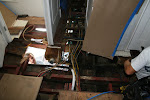
On “Sirius,” we are replacing the shaft logs. Both suffered from electrical discharge. The amount of electrical flow was enough to remove all the lignum in the wood. (See photo.) The new captain, Dave Culver, and I are working on resolving the problem.
Remember last summer I wrote about this same problem on my boat, “Aurora II.” Nate has dealt with it on other Trumpy yachts. On my boat, I removed the bonding system and installed an isolated grounding dynaplate and rerouted my grounds. My DC goes to ground then jumps to the motor ground. The AC grounds to the motors and there is a galvanic isolator on the shore power ground. Also, I shut off the motor starting batteries and shut off the gauge switch. This is an expensive repair and the changes to prevent problems are a lot cheaper.
I needed some technical advice on the project so I called my old friend John Whitney. John is an expert in fixing antique equipment. I got him on the phone line and he told me he couldn’t talk right then. “They’re loading my new boat on a freighter,” John said. “I am out in Vancouver and I will see you soon, a week or two.” Then there was a click.
John and Janet have lived on their schooner “Winterwind” for a long time and John had mentioned he might want a power boat. What I might tell you might sound crazy but not if you know John. He called me when his boat was being unloaded. She’s green and built in 1897 and a tug. Sounded about right for John and Janet. I knew she had to be beautiful. The “Wallace Foss,” see photos, is a beauty. John loves machinery and Foss has a lot of it and should keep him busy.
She has been converted to a work yacht. She has a Caterpillar motor with a pony motor for a starter. So I thought great, John and Janet will be spending the winter with us down south in Florida. Nope. John stopped by to provision and his crew was flying in so they could head back north to Newport. I told John he was crazy. “Jim, you already knew that,” John said.
The next morning, the lines were slid aboard and this beautiful tug slipped from the dock. I watched as they headed out.
I called John after he got home to Newport, R.I. Leaving Palm Beach, Fossy’s hull was tight as a drum, John said. But some of the doors and the crew’s quarter scuttle leaked after hitting eight to 10 feet seas. The crew was swimming in their bunks so they pulled into Fernandina Beach in Florida to solve those problems and dry out. Taking her up the Intracoastal with nine feet of draft wasn’t an option. The rest of the trip went well. She burned three gallons per hour at eight knots. John and Janet are glad to be home and Wallace Fossy has a new home port.
Moving on, as I pulled up to Rybovich Yacht Center where we do our work in Florida, the security guard asked which big Trumpy is that. I said, “Wishing Star?” “No, bigger,” he said. It was “Freedom,” the 103’ 1926, Contract 181, built for Albert G. Fay.
Capt. Jeff and I have known each other for a long time so it was good to catch up. They were there to clean the carpets and provision and were heading off to the Bahamas.
To have four of these great yachts in one place, Freedom, Wishing Star, Sirius and our little Aurora II, was a sight to behold.
So why I am sitting on an airplane? The story starts back at Ocean Reef’s Vintage Weekend in December. Cindy Purcell and I were talking about launches. I said what if we dusted off a set of her grandfather’s old plans, kept the classic lines and updated the functions and designed a beautiful classic launch for these megayachts?
Cindy said she was game. Cindy is the granddaughter of Frank Huckins, who founded Huckins Boat Co., in Jacksonville, Fl. I told her I wasn’t playing. I was serious and really wanted to do it. She told me to come up to Jacksonville and we could work on it. So when I got a call from Cindy recently I figured it was about the launch idea. Instead, Cindy wanted to know if I would be interested in looking at the oldest Huckins still around, the 1931 48’ Avocette III built for Fred Voges. She wanted to know if we would be interested in a joint project. Of course I would.
Cindy’s husband Buddy Purcell and I headed off to Rhode Island to take a look at Avocette III for one of their clients. Flying into Providence I rented a car. The rental car clerk asked what mid-sized car I wanted. She went down the list and a Camaro happened to be one of them. As we walked out to the cars, there was a jet black Camaro SS. It looked liked the Batmobile, a hopped up young man’s dream car, fast, frisky and fun. Driving down to the boat, I had a couple of young guys want to race me or just drive up and wonder what this old coot was doing behind the wheel. I still can’t get over seeing myself in the mirror and having some old guy looking back at me. Where did the time go?
Arriving in Portsmouth, there she was, covered and sleeping. Unzipping the door I had no idea what to expect. After spending the day with her, I wrote this down:
I had my reservations about flying up to see Avocette. I’ve seen many amateur restorations over the years and they often are so profoundly bad, there is little left of the original boat and it is no longer worth restoring.
This was not the case with Avocette III.
What I found was a very original boat and that the restoration that Jerry Bass had done was of high quality.
The Avocette is a true marvel of pre-war innovations and technology. From the long commuter, piercing hull to the inverted lifts built in her bottom to help her plane at low speeds.
In my 35 years in wooden boat restorations I have never seen a boat this size constructed in this fashion. Avocette may be the oldest and possibly even the only existing example of this type of boat construction.
Frank Huckins masterfully blended batten seam technology with a much lighter construction method. This yacht deserves not only restoration but should be put into a museum or a private collection.
My other notes were a plan of attack. I had a restoration plan in my head and I needed to put it down on paper. Buddy and I spent some time together looking at other boats.
One very special Huckins is a 1936 Sportsman, “Mermaid.” The first time I saw this boat, I stopped in my tracks. With her tear drop windshield and her dropped sheer, she’s a sight to behold. From looking at “Avocette II,” designed in 1931, to the “Mermaid,” Frank Huckins boats had giant leap forward. From batten seam to cold molding, his artist’s eye for styling was masterfully executed.
My last story is on a dear friend who stopped by for a visit. Donald Trumpy, grandson of John Sr. He grew up in the yard and worked there for a while so he is a wealth of knowledge. I’m glad we had a few Trumpy yachts here when he came by. But Don said it was anything but a busman’s holiday. “I’ve been out of the boat business for 30 plus years. I just like looking at my family’s work survive and be appreciated,” he said.
I took him aboard the “Honey Fitz” and told him about my research on her conversation to the presidential yacht by his family’s yard. I found a Yachting magazine advertisement from 1954 for Panish controls that stated that the newly refitted “Barbara Ann” recently completed at John Trumpy & Sons chose Panish controls for the presidential yacht.
Don smiled. “You never asked about the “Barbara Ann.” You asked me about “Honey Fitz.” She wouldn’t have been “Honey Fitz” back in 1954.”
I don’t get to see Don often and I’m glad he stopped by. It’s always good to see him.
Until next time,
Jim Moores
Dear friends,
I’m sitting here in Charlotte, N.C. airport waiting for take off. We are number 17 in line. This has been a great month. Nate Smith, my partner, is closing in on the Wheeler that will be Pilar for the film Hemingway & Fuentes. The new motor is in, planks and more planks are going up and the painters are coming in at night and weekends to keep to a tight schedule.
In the paint shed is “Chesapeake,” the 1963, 61’ foot Trumpy, Contract 379 owned by Peter Anzo.
In Florida, we are working on “Wishing Star,” the 83 foot 1963 Trumpy, contract 407, built for Col. David Wagstaff. She is in for some minor wood work and paint. She is a glorius girl, a proper yacht. So what could be better? Two Trumpy yachts. The second is the 1964 “Sirius,” 60’, Contract 412, built for Henry Gibson.
On “Sirius,” we are replacing the shaft logs. Both suffered from electrical discharge. The amount of electrical flow was enough to remove all the lignum in the wood. (See photo.) The new captain, Dave Culver, and I are working on resolving the problem.
Remember last summer I wrote about this same problem on my boat, “Aurora II.” Nate has dealt with it on other Trumpy yachts. On my boat, I removed the bonding system and installed an isolated grounding dynaplate and rerouted my grounds. My DC goes to ground then jumps to the motor ground. The AC grounds to the motors and there is a galvanic isolator on the shore power ground. Also, I shut off the motor starting batteries and shut off the gauge switch. This is an expensive repair and the changes to prevent problems are a lot cheaper.
I needed some technical advice on the project so I called my old friend John Whitney. John is an expert in fixing antique equipment. I got him on the phone line and he told me he couldn’t talk right then. “They’re loading my new boat on a freighter,” John said. “I am out in Vancouver and I will see you soon, a week or two.” Then there was a click.
John and Janet have lived on their schooner “Winterwind” for a long time and John had mentioned he might want a power boat. What I might tell you might sound crazy but not if you know John. He called me when his boat was being unloaded. She’s green and built in 1897 and a tug. Sounded about right for John and Janet. I knew she had to be beautiful. The “Wallace Foss,” see photos, is a beauty. John loves machinery and Foss has a lot of it and should keep him busy.
She has been converted to a work yacht. She has a Caterpillar motor with a pony motor for a starter. So I thought great, John and Janet will be spending the winter with us down south in Florida. Nope. John stopped by to provision and his crew was flying in so they could head back north to Newport. I told John he was crazy. “Jim, you already knew that,” John said.
The next morning, the lines were slid aboard and this beautiful tug slipped from the dock. I watched as they headed out.
I called John after he got home to Newport, R.I. Leaving Palm Beach, Fossy’s hull was tight as a drum, John said. But some of the doors and the crew’s quarter scuttle leaked after hitting eight to 10 feet seas. The crew was swimming in their bunks so they pulled into Fernandina Beach in Florida to solve those problems and dry out. Taking her up the Intracoastal with nine feet of draft wasn’t an option. The rest of the trip went well. She burned three gallons per hour at eight knots. John and Janet are glad to be home and Wallace Fossy has a new home port.
Moving on, as I pulled up to Rybovich Yacht Center where we do our work in Florida, the security guard asked which big Trumpy is that. I said, “Wishing Star?” “No, bigger,” he said. It was “Freedom,” the 103’ 1926, Contract 181, built for Albert G. Fay.
Capt. Jeff and I have known each other for a long time so it was good to catch up. They were there to clean the carpets and provision and were heading off to the Bahamas.
To have four of these great yachts in one place, Freedom, Wishing Star, Sirius and our little Aurora II, was a sight to behold.
So why I am sitting on an airplane? The story starts back at Ocean Reef’s Vintage Weekend in December. Cindy Purcell and I were talking about launches. I said what if we dusted off a set of her grandfather’s old plans, kept the classic lines and updated the functions and designed a beautiful classic launch for these megayachts?
Cindy said she was game. Cindy is the granddaughter of Frank Huckins, who founded Huckins Boat Co., in Jacksonville, Fl. I told her I wasn’t playing. I was serious and really wanted to do it. She told me to come up to Jacksonville and we could work on it. So when I got a call from Cindy recently I figured it was about the launch idea. Instead, Cindy wanted to know if I would be interested in looking at the oldest Huckins still around, the 1931 48’ Avocette III built for Fred Voges. She wanted to know if we would be interested in a joint project. Of course I would.
Cindy’s husband Buddy Purcell and I headed off to Rhode Island to take a look at Avocette III for one of their clients. Flying into Providence I rented a car. The rental car clerk asked what mid-sized car I wanted. She went down the list and a Camaro happened to be one of them. As we walked out to the cars, there was a jet black Camaro SS. It looked liked the Batmobile, a hopped up young man’s dream car, fast, frisky and fun. Driving down to the boat, I had a couple of young guys want to race me or just drive up and wonder what this old coot was doing behind the wheel. I still can’t get over seeing myself in the mirror and having some old guy looking back at me. Where did the time go?
Arriving in Portsmouth, there she was, covered and sleeping. Unzipping the door I had no idea what to expect. After spending the day with her, I wrote this down:
I had my reservations about flying up to see Avocette. I’ve seen many amateur restorations over the years and they often are so profoundly bad, there is little left of the original boat and it is no longer worth restoring.
This was not the case with Avocette III.
What I found was a very original boat and that the restoration that Jerry Bass had done was of high quality.
The Avocette is a true marvel of pre-war innovations and technology. From the long commuter, piercing hull to the inverted lifts built in her bottom to help her plane at low speeds.
In my 35 years in wooden boat restorations I have never seen a boat this size constructed in this fashion. Avocette may be the oldest and possibly even the only existing example of this type of boat construction.
Frank Huckins masterfully blended batten seam technology with a much lighter construction method. This yacht deserves not only restoration but should be put into a museum or a private collection.
My other notes were a plan of attack. I had a restoration plan in my head and I needed to put it down on paper. Buddy and I spent some time together looking at other boats.
One very special Huckins is a 1936 Sportsman, “Mermaid.” The first time I saw this boat, I stopped in my tracks. With her tear drop windshield and her dropped sheer, she’s a sight to behold. From looking at “Avocette II,” designed in 1931, to the “Mermaid,” Frank Huckins boats had giant leap forward. From batten seam to cold molding, his artist’s eye for styling was masterfully executed.
My last story is on a dear friend who stopped by for a visit. Donald Trumpy, grandson of John Sr. He grew up in the yard and worked there for a while so he is a wealth of knowledge. I’m glad we had a few Trumpy yachts here when he came by. But Don said it was anything but a busman’s holiday. “I’ve been out of the boat business for 30 plus years. I just like looking at my family’s work survive and be appreciated,” he said.
I took him aboard the “Honey Fitz” and told him about my research on her conversation to the presidential yacht by his family’s yard. I found a Yachting magazine advertisement from 1954 for Panish controls that stated that the newly refitted “Barbara Ann” recently completed at John Trumpy & Sons chose Panish controls for the presidential yacht.
Don smiled. “You never asked about the “Barbara Ann.” You asked me about “Honey Fitz.” She wouldn’t have been “Honey Fitz” back in 1954.”
I don’t get to see Don often and I’m glad he stopped by. It’s always good to see him.
Until next time,
Jim Moores
June 2012
June 2012
Dear Friends,
Recently, we have been bringing smaller boats to our shop here in Florida. In our tent is a 36-foot Windsorcraft with a dark blue hull and varnished deck. She’s a true beauty. Built in Turkey, the “Party Girl II” is the perfect boat for just that. The boat lives on Lake Minnetonka in Minnesota. The other project is very neat. The 28-foot “Downwind,” is the only one of her kind left. Designed and built by William H. Albury in 1954 in Man-O-War Cay, Abacos, Bahamas. Mr. Albury is probably the most famous of all the Bahamian designer-builders.
The first time I heard the name Albury, I was a much younger man. It was in the summer of 1971, I was 16. I got a job helping on a delivery to Nassau. Back in those days, it was a different world. Wooden fishing sloops lying on the beach, getting work done. Beautiful clipper bows with trail boards and wine-glass transoms with “leg of mutton” rigs, which means the mast is as tall as the boom is long.
I was smitten by these amazing watercrafts as I walked along the beach and talked to the locals. There were different islands and each had their variations. There were even races. Names like Knowles, Pinder and Sawyer were all out island builders.
One day, as we sat aboard at Yacht Haven, this amazingly beautiful schooner sailed in and tied up. I walked out to meet her and grab a line. “Herreshoff?” I asked. The man on deck look insulted and said, “Albury, William H. Albury. He’s Bahamian.”
“Uncle Will” to many was a great builder but an even greater designer. No computers. He did it the old way, with half models. But most importantly, he had a boat builder’s eye. He designed and built by eye, which is a dying art if not already gone in the islands.
So when I got a call from Greg Talbott to go look at his 1954 Albury, I jumped. Greg’s story was simple: The day and age of wooden boat builders in the Abacos ended with the passing of the last generation. He had brought her to the states to have her hull fiber glassed. He had given up trying to find capable wooden boat builders. Then, someone mentioned my name to him.
When I first saw the boat, it had been soda blasted and “Downwind’s” planking is eastern Atlantic cedar. She looked weather battered. Stephanie, my partner, said the boat looked tired. But what I saw was the most beautiful little 28-foot motorboat. On the drive back to the shop, I remember thinking to myself this is why I do what I do. This boat should not be fiber glassed. Now, we are almost done. Five new planks on the top side, six on the bottom, 1,800 silcon bronze fasteners and a new transom. Refairing and paint will be next. I think this passion is slowly working its way into my son, James.
After coming home from a Boy Scout meeting, Troop 141, James said “ Dad, my Boy Scout Troop wants to build a boat for a race. I told them we could build it at our shop!” I thought to myself that my place is not set up for 20 kids. There are too many sharp objects. So after setting some serious ground rules, on two Saturday mornings, scouts came in ones and twos. Eventually, there was a lot of them.
For building materials, they brought six 55-gallon drums, four 2x4s and four sheets of plywood. This was to be the boat? So I asked what kind of boat? One of the leaders told me that it was for a paddle barge and the foam will be here next week. We are going to carve out a boat from Styrofoam, then put some plywood to hold it together? I looked at the boys and asked, “Do you want to build a real boat?” Their eyes glimmered and all at once, a loud “Yes” came out of all of them. I grabbed a piece of cardboard and
The tools were to be simple: a key hole hand saw, a staple gun, a battery drill and a hand block plane. The goal was to get as many of their hands on it as we could. James kind of knew what he was supposed to do from building the remote control boat, so he stepped up to the challenge. Troop 141 was not only building one boat but two, and on two Saturdays. The materials for the original boat planned would be used for a “party barge.”
So we got “The Flying Tiger” cut out, one boy zip tightening and drilling. The hard part was when we mixed up all the epoxy and filled the corners with a fillet of thickened epoxy. Everybody left with a little red epoxy somewhere on their bodies or clothes. Painted with house paint, the boat received finishing touches from our artist Steve Kneipp. He painted an open jaw of a shark. She looked good. I had a concern that if a boy jumped in, he might go through the door skin bottom, so we put a little extra in the bottom.
If you don’t know what door skin is, it’s the 1/16” plywood that is used to sheath cheap interior doors. We use it for pattern stock. The boats were loaded and carried up to the river raft race where all the regional boy scouts from as far as Miami to Daytona came. I was a little nervous when I went up there. There were rafts, catamarans, and a lot of barges, long ones, short ones and then there was our boys’ boat, weighing less than 70 lbs., 16 ft. long, 2-1/2 ft. wide, she was sleek. I left before ours raced. Besides, it was the scouts’ race, right?
Most of the boats took 30 minutes to an hour. When the “Flying Tiger” ran the course, they were back in 15 minutes. The judges didn’t know what to do. I heard later that was the fastest a boat has ever run the course. James was excited. He is already thinking of the next one: “I know what I want to design for next year!”
Until next time,
Jim Moores
Dear Friends,
Recently, we have been bringing smaller boats to our shop here in Florida. In our tent is a 36-foot Windsorcraft with a dark blue hull and varnished deck. She’s a true beauty. Built in Turkey, the “Party Girl II” is the perfect boat for just that. The boat lives on Lake Minnetonka in Minnesota. The other project is very neat. The 28-foot “Downwind,” is the only one of her kind left. Designed and built by William H. Albury in 1954 in Man-O-War Cay, Abacos, Bahamas. Mr. Albury is probably the most famous of all the Bahamian designer-builders.
The first time I heard the name Albury, I was a much younger man. It was in the summer of 1971, I was 16. I got a job helping on a delivery to Nassau. Back in those days, it was a different world. Wooden fishing sloops lying on the beach, getting work done. Beautiful clipper bows with trail boards and wine-glass transoms with “leg of mutton” rigs, which means the mast is as tall as the boom is long.
I was smitten by these amazing watercrafts as I walked along the beach and talked to the locals. There were different islands and each had their variations. There were even races. Names like Knowles, Pinder and Sawyer were all out island builders.
One day, as we sat aboard at Yacht Haven, this amazingly beautiful schooner sailed in and tied up. I walked out to meet her and grab a line. “Herreshoff?” I asked. The man on deck look insulted and said, “Albury, William H. Albury. He’s Bahamian.”
“Uncle Will” to many was a great builder but an even greater designer. No computers. He did it the old way, with half models. But most importantly, he had a boat builder’s eye. He designed and built by eye, which is a dying art if not already gone in the islands.
So when I got a call from Greg Talbott to go look at his 1954 Albury, I jumped. Greg’s story was simple: The day and age of wooden boat builders in the Abacos ended with the passing of the last generation. He had brought her to the states to have her hull fiber glassed. He had given up trying to find capable wooden boat builders. Then, someone mentioned my name to him.
When I first saw the boat, it had been soda blasted and “Downwind’s” planking is eastern Atlantic cedar. She looked weather battered. Stephanie, my partner, said the boat looked tired. But what I saw was the most beautiful little 28-foot motorboat. On the drive back to the shop, I remember thinking to myself this is why I do what I do. This boat should not be fiber glassed. Now, we are almost done. Five new planks on the top side, six on the bottom, 1,800 silcon bronze fasteners and a new transom. Refairing and paint will be next. I think this passion is slowly working its way into my son, James.
After coming home from a Boy Scout meeting, Troop 141, James said “ Dad, my Boy Scout Troop wants to build a boat for a race. I told them we could build it at our shop!” I thought to myself that my place is not set up for 20 kids. There are too many sharp objects. So after setting some serious ground rules, on two Saturday mornings, scouts came in ones and twos. Eventually, there was a lot of them.
For building materials, they brought six 55-gallon drums, four 2x4s and four sheets of plywood. This was to be the boat? So I asked what kind of boat? One of the leaders told me that it was for a paddle barge and the foam will be here next week. We are going to carve out a boat from Styrofoam, then put some plywood to hold it together? I looked at the boys and asked, “Do you want to build a real boat?” Their eyes glimmered and all at once, a loud “Yes” came out of all of them. I grabbed a piece of cardboard and
a magic marker and crude plans. My first question was “how long does this boat have to stay afloat, 2 hours?” The answer was maybe that or less. Three sheets of door skin, a bag of electric zip ties and a two-gallon kit of epoxy bonding agent that Teak Deck Systems had given me to test, (I don’t think this was what they had in mind). I helped mark out the first piece, but from then on, this was to be their boat.
The tools were to be simple: a key hole hand saw, a staple gun, a battery drill and a hand block plane. The goal was to get as many of their hands on it as we could. James kind of knew what he was supposed to do from building the remote control boat, so he stepped up to the challenge. Troop 141 was not only building one boat but two, and on two Saturdays. The materials for the original boat planned would be used for a “party barge.”
So we got “The Flying Tiger” cut out, one boy zip tightening and drilling. The hard part was when we mixed up all the epoxy and filled the corners with a fillet of thickened epoxy. Everybody left with a little red epoxy somewhere on their bodies or clothes. Painted with house paint, the boat received finishing touches from our artist Steve Kneipp. He painted an open jaw of a shark. She looked good. I had a concern that if a boy jumped in, he might go through the door skin bottom, so we put a little extra in the bottom.
If you don’t know what door skin is, it’s the 1/16” plywood that is used to sheath cheap interior doors. We use it for pattern stock. The boats were loaded and carried up to the river raft race where all the regional boy scouts from as far as Miami to Daytona came. I was a little nervous when I went up there. There were rafts, catamarans, and a lot of barges, long ones, short ones and then there was our boys’ boat, weighing less than 70 lbs., 16 ft. long, 2-1/2 ft. wide, she was sleek. I left before ours raced. Besides, it was the scouts’ race, right?
Most of the boats took 30 minutes to an hour. When the “Flying Tiger” ran the course, they were back in 15 minutes. The judges didn’t know what to do. I heard later that was the fastest a boat has ever run the course. James was excited. He is already thinking of the next one: “I know what I want to design for next year!”
Until next time,
Jim Moores
Monday, February 21, 2011
January 2011
January 2011
Dear friends,
I recently was in Fort Lauderdale and there in the shed at the Roscioli boatyard was “Annabelle,” a 1955 Trumpy, Contract 372, built for William McKelvy. Annabelle has had many names over the years, starting with “Rumak III,” and “Bettco” then “Windsong.”
Working on her was Barry Oliver, the mate. I have known Barry for many years, back to the days when he worked on “Aurora V,” then owned by Carolyn Weaver. Barry is a true master at what he does and he keeps up Annabelle beautifully.
As we talked about his summer in Maine, it took me back to the first time I had seen “Annabelle.” The year was 1996. A yacht broker from Palm Beach had asked me to take a look at a project boat. We drove to Stuart, Fl. There, way up in the South Fork of the St. Lucie River, sat old “Rumak.” She had been laid open and low. There was fiberglass on the cabin tops with the resin burned out. Someone had changed the pilothouse and her interior doors, cabinets and trim lay in a pile. On the port side, a ficus tree with a five-inch trunk grew out the side. It was a miserable sight.
The broker wanted us to tow her to a shipyard in West Palm Beach where we could check out her bottom and do the work.
We were at the tail end of a major structural refit on another Trumpy, the 1960 “Fairlee,” Contract 393. I had the “Sirius” then, a 1956, 36’ Stonington motor sailor. Nate Smith, Epoxy Mike Doyle, Ryan Schlagel and I embarked on what was to be an ill-fated adventure.
Before we agreed to tow the boat, I wanted to see authorization. The broker pulled out signed papers that looked official. She was to be towed, hauled out and surveyed. It sounded simple enough.
We took “Sirius” by way of the ocean from Palm Beach to the St. Lucie Inlet. Sirius’ old engine kept overheating and in rolling seas, opening the heavy engine hatch and pouring water into the heat exchangers was tricky. Once we reached the South Fork, it got worse. It was like a snake, twisting and turning and a real work out on the wheel.
“Sirius” drew five feet and we touched bottom a few times. Powering through, we reached “Rumak III.” Nate saw the tree growing out of her side, and cut it down right away before we left the dock. It was an insult. The broker took the wheel aboard the Trumpy and I helmed “Sirius” and we paved out 50 to 60 feet of line with lead weights. “Sirius” had two white oak Samson posts so we rigged up a bridle.
The 85 hp diesel with a four blade 24x24 square prop on my old boat had torque. At first, everything went pretty smoothly but when we reached the twists and turns in the river, all hell broke loose. The broker wasn’t paying attention so Rumak’s bow sailed into the mangroves. She was hard aground. I just increased the speed and behind my boat, the root beer water churned and the soft silt seemed to wash away. “Rumak III” slowly started to move. We repeated this many times until we finally cleared the South Fork.
The sun was setting as we passed Manatee Pocket and then we entered the Intracoastal Waterway. It was a little tricky and the same thing happened, the Trumpy grounded. But, this time it was sand and not muck. The tide was coming in and we would have to sit and wait.
That’s when the Florida Marine Patrol came up to us with guns drawn. It turned out that the man selling the boat was not the legal owner of “Rumak III.” As the broker from Palm Beach talked fast to authorities, we started to float back, then “Rumak III” did as well.
“We can’t stay here,” I told the officers. “I have to put my boat in gear and real soon.” They decided we needed to tow her back to Manatee Pocket. We did and tied off Rumak there. They realized we were just towing the boat, and they let us go. We left the Palm Beach broker, who had nearly gotten us all arrested, to fend for himself.
It would be years until we would see her again. A doctor who had owned her before bought her back and had just returned from the Bahamas. Her name was now Windsong. He hauled her out at Cracker Boy Boatworks. Her rudder blocks were rotten and her packing glands electrolyzed on the inside into the wood.
The repairs were simple. The doctor showed me the boat. He had hired house carpenters and done most of the work from materials bought at Home Depot. It looked it. It seemed most, if not all, of her original parts had been thrown away. Years later, I ran into the doctor and he told me that he had sold her, the boat had been taken to the Hinckley yard in Maine and been refitted. I was glad to hear it.
The next time I saw her was at Rybovich Spencer in 2000 and her name was in beautiful gold leaf, “Osceola.” Seeing her back together and back from the grave, delighted me. Although I never met the man who owned her at the time, he had saved a great yacht. He had seen the dream, what she once was, and gave her back her dignity and grace.
So standing at the dock at Roscioli and talking with Barry and the captain, I had a deep appreciation of what she had become and what she had been through to get there.
That trip up the South Fork has always stayed with me. I decided to retrace the trip, minus the police action, on Aurora II, our 1947 Trumpy. My son James, 12, and I readied the boat. I would do the driving and try to teach him along the way. James was a natural. He steers like an old salt. Aurora has twin 471 GMC diesels, 175 hp each, and does 7 to 9 knots. She takes a little time to respond so someone not used to it will overcompensate and zig zag. Not James. He got the feel of her wheel right away.
We spent the night in Manatee Pocket and had short visit with Bill Iler on Windrush. They were catching up on their varnish work. In the morning, the foredeck was covered in frost. James scooped it up and made a ball. He said, “Dad, look. It’s a Florida snow ball.” We fired up the motors and headed to the South Fork
It was the first time we had cruised Aurora with just the three of us so Stephanie had two James to chauffer her around. As we made it into the South Fork, it was as beautiful as I had remembered. The harrowing twists and turns were still there and “Aurora” could not make the turns without using shifters, pulling one in reverse and the other forward. “Aurora” is 61 feet. The “Rumak III” was 79 feet long. It was amazing that we could have towed her out at all. Mangroves lined the river, dotted with red berries and flowers. Cranes, egrets and osprey watched us pass from tall branches and the blue skies above and coffee color water below made the view gorgeous.
I was talking to Stephanie and took my eyes off the river for a few seconds and just like that, we were aground. It wasn’t like running up on sand or rocks, more like running aground on down pillows, if there was such a thing. I put both motors in reverse and she slid right out of it. On our return back, James and I spent most of our time in the pilothouse, with Stephanie catching up on her reading on the aft deck. I found treasure on the trip, spending time aboard with my family.
Before I end this letter, I have some Trumpy news.
Capt. Howard “Butch” Weikel has passed away. He was the captain of the Trumpy “Stargazer” for more than 20 years and before that, he helmed the Trumpy “Paradise,” which is now “Glory.” Capt. Butch was one of the greats of the “Greatest Generation.” A World War II vet, straight shooter, kind, and as honorable and loyal to his boats and his employers as they come. He will be truly missed.
I recently received some information on a 87-foot Trumpy built in 1934, Contract 219, the “Elsie Fenimore,” now called “Carolina Rose” built for E.R. Fenimore Johnson, a pioneer in underwater photography, who financed the Academy of Science’s 1931 expedition to Brazil. She went to California shortly after she was built and has been there ever since. Her last owner has passed away and his wife is looking for a suitable new owner. The yacht has a 200 hp Superior, which is the original motor and in good working conditions. See the photo.
In other news, I went down to spend a day with my old friend Joe Bartram. After lunch, we went on a little trip to visit the 1939 “Drifter,” contract 244, built for Frank O. Sherill. She is a 76-feet houseboat, long and lean, with graceful lines of a prewar Trumpy. There is a lot to work with and all she needs is a suitable patron that can see the dream and bring her back to her former glory. Both of these yachts are worthy projects for consideration. They still have their souls. If you would like to know more, please call Joe. I don’t know any more about these boats than what I’ve put here. Joe’s number is 954-522-5075 or email him at jbbartjr@bartbrak.com.
Finally, I recently received a message from an old friend, Derek Jarvis. We haven’t seen each other in 38 years. As young men, Derek was 24, and I was 18, we shared a common dream to sail to faraway places. Derek’s was to sail around the world. Mine wasn’t as big. I just wanted to make it to the Caribbean. I owned a 36 foot Hilyard, the “Solan Goose,” built in England. Derek had a 30-foot Pearson. For me, it was about the destination. San Salvador, then St. Thomas, Dominica, Martinique, and so on. As young men, the journey was not as important as getting there, to these exotic destinations.
Derek, on “Deliverance” (named before the movie) would make it to Australia. Change out boats and sail on, completing his dream. For me, being broke in the islands turned me north to Maine to learn to build wooden boats.
Age and Aurora have changed my perspective. The previous owner had her for 40 years and he used her every week, never going far, just taking short trips around Miami with friends on board. When Aurora became ours, we tried to do the same. Every week that we can, we untie her, James and I are getting really good at undocking, and set out on a short cruise with good friends as company. The conversation swirls on the back deck and in the pilothouse. And we usually take the same route on the Intracoastal, the same destinations. But I now know it’s about the journey.
Until next time,
Jim Moores
Dear friends,
I recently was in Fort Lauderdale and there in the shed at the Roscioli boatyard was “Annabelle,” a 1955 Trumpy, Contract 372, built for William McKelvy. Annabelle has had many names over the years, starting with “Rumak III,” and “Bettco” then “Windsong.”
Working on her was Barry Oliver, the mate. I have known Barry for many years, back to the days when he worked on “Aurora V,” then owned by Carolyn Weaver. Barry is a true master at what he does and he keeps up Annabelle beautifully.
As we talked about his summer in Maine, it took me back to the first time I had seen “Annabelle.” The year was 1996. A yacht broker from Palm Beach had asked me to take a look at a project boat. We drove to Stuart, Fl. There, way up in the South Fork of the St. Lucie River, sat old “Rumak.” She had been laid open and low. There was fiberglass on the cabin tops with the resin burned out. Someone had changed the pilothouse and her interior doors, cabinets and trim lay in a pile. On the port side, a ficus tree with a five-inch trunk grew out the side. It was a miserable sight.
The broker wanted us to tow her to a shipyard in West Palm Beach where we could check out her bottom and do the work.
We were at the tail end of a major structural refit on another Trumpy, the 1960 “Fairlee,” Contract 393. I had the “Sirius” then, a 1956, 36’ Stonington motor sailor. Nate Smith, Epoxy Mike Doyle, Ryan Schlagel and I embarked on what was to be an ill-fated adventure.
Before we agreed to tow the boat, I wanted to see authorization. The broker pulled out signed papers that looked official. She was to be towed, hauled out and surveyed. It sounded simple enough.
We took “Sirius” by way of the ocean from Palm Beach to the St. Lucie Inlet. Sirius’ old engine kept overheating and in rolling seas, opening the heavy engine hatch and pouring water into the heat exchangers was tricky. Once we reached the South Fork, it got worse. It was like a snake, twisting and turning and a real work out on the wheel.
“Sirius” drew five feet and we touched bottom a few times. Powering through, we reached “Rumak III.” Nate saw the tree growing out of her side, and cut it down right away before we left the dock. It was an insult. The broker took the wheel aboard the Trumpy and I helmed “Sirius” and we paved out 50 to 60 feet of line with lead weights. “Sirius” had two white oak Samson posts so we rigged up a bridle.
The 85 hp diesel with a four blade 24x24 square prop on my old boat had torque. At first, everything went pretty smoothly but when we reached the twists and turns in the river, all hell broke loose. The broker wasn’t paying attention so Rumak’s bow sailed into the mangroves. She was hard aground. I just increased the speed and behind my boat, the root beer water churned and the soft silt seemed to wash away. “Rumak III” slowly started to move. We repeated this many times until we finally cleared the South Fork.
The sun was setting as we passed Manatee Pocket and then we entered the Intracoastal Waterway. It was a little tricky and the same thing happened, the Trumpy grounded. But, this time it was sand and not muck. The tide was coming in and we would have to sit and wait.
That’s when the Florida Marine Patrol came up to us with guns drawn. It turned out that the man selling the boat was not the legal owner of “Rumak III.” As the broker from Palm Beach talked fast to authorities, we started to float back, then “Rumak III” did as well.
“We can’t stay here,” I told the officers. “I have to put my boat in gear and real soon.” They decided we needed to tow her back to Manatee Pocket. We did and tied off Rumak there. They realized we were just towing the boat, and they let us go. We left the Palm Beach broker, who had nearly gotten us all arrested, to fend for himself.
It would be years until we would see her again. A doctor who had owned her before bought her back and had just returned from the Bahamas. Her name was now Windsong. He hauled her out at Cracker Boy Boatworks. Her rudder blocks were rotten and her packing glands electrolyzed on the inside into the wood.
The repairs were simple. The doctor showed me the boat. He had hired house carpenters and done most of the work from materials bought at Home Depot. It looked it. It seemed most, if not all, of her original parts had been thrown away. Years later, I ran into the doctor and he told me that he had sold her, the boat had been taken to the Hinckley yard in Maine and been refitted. I was glad to hear it.
The next time I saw her was at Rybovich Spencer in 2000 and her name was in beautiful gold leaf, “Osceola.” Seeing her back together and back from the grave, delighted me. Although I never met the man who owned her at the time, he had saved a great yacht. He had seen the dream, what she once was, and gave her back her dignity and grace.
So standing at the dock at Roscioli and talking with Barry and the captain, I had a deep appreciation of what she had become and what she had been through to get there.
That trip up the South Fork has always stayed with me. I decided to retrace the trip, minus the police action, on Aurora II, our 1947 Trumpy. My son James, 12, and I readied the boat. I would do the driving and try to teach him along the way. James was a natural. He steers like an old salt. Aurora has twin 471 GMC diesels, 175 hp each, and does 7 to 9 knots. She takes a little time to respond so someone not used to it will overcompensate and zig zag. Not James. He got the feel of her wheel right away.
We spent the night in Manatee Pocket and had short visit with Bill Iler on Windrush. They were catching up on their varnish work. In the morning, the foredeck was covered in frost. James scooped it up and made a ball. He said, “Dad, look. It’s a Florida snow ball.” We fired up the motors and headed to the South Fork
It was the first time we had cruised Aurora with just the three of us so Stephanie had two James to chauffer her around. As we made it into the South Fork, it was as beautiful as I had remembered. The harrowing twists and turns were still there and “Aurora” could not make the turns without using shifters, pulling one in reverse and the other forward. “Aurora” is 61 feet. The “Rumak III” was 79 feet long. It was amazing that we could have towed her out at all. Mangroves lined the river, dotted with red berries and flowers. Cranes, egrets and osprey watched us pass from tall branches and the blue skies above and coffee color water below made the view gorgeous.
I was talking to Stephanie and took my eyes off the river for a few seconds and just like that, we were aground. It wasn’t like running up on sand or rocks, more like running aground on down pillows, if there was such a thing. I put both motors in reverse and she slid right out of it. On our return back, James and I spent most of our time in the pilothouse, with Stephanie catching up on her reading on the aft deck. I found treasure on the trip, spending time aboard with my family.
Before I end this letter, I have some Trumpy news.
Capt. Howard “Butch” Weikel has passed away. He was the captain of the Trumpy “Stargazer” for more than 20 years and before that, he helmed the Trumpy “Paradise,” which is now “Glory.” Capt. Butch was one of the greats of the “Greatest Generation.” A World War II vet, straight shooter, kind, and as honorable and loyal to his boats and his employers as they come. He will be truly missed.
I recently received some information on a 87-foot Trumpy built in 1934, Contract 219, the “Elsie Fenimore,” now called “Carolina Rose” built for E.R. Fenimore Johnson, a pioneer in underwater photography, who financed the Academy of Science’s 1931 expedition to Brazil. She went to California shortly after she was built and has been there ever since. Her last owner has passed away and his wife is looking for a suitable new owner. The yacht has a 200 hp Superior, which is the original motor and in good working conditions. See the photo.
In other news, I went down to spend a day with my old friend Joe Bartram. After lunch, we went on a little trip to visit the 1939 “Drifter,” contract 244, built for Frank O. Sherill. She is a 76-feet houseboat, long and lean, with graceful lines of a prewar Trumpy. There is a lot to work with and all she needs is a suitable patron that can see the dream and bring her back to her former glory. Both of these yachts are worthy projects for consideration. They still have their souls. If you would like to know more, please call Joe. I don’t know any more about these boats than what I’ve put here. Joe’s number is 954-522-5075 or email him at jbbartjr@bartbrak.com.
Finally, I recently received a message from an old friend, Derek Jarvis. We haven’t seen each other in 38 years. As young men, Derek was 24, and I was 18, we shared a common dream to sail to faraway places. Derek’s was to sail around the world. Mine wasn’t as big. I just wanted to make it to the Caribbean. I owned a 36 foot Hilyard, the “Solan Goose,” built in England. Derek had a 30-foot Pearson. For me, it was about the destination. San Salvador, then St. Thomas, Dominica, Martinique, and so on. As young men, the journey was not as important as getting there, to these exotic destinations.
Derek, on “Deliverance” (named before the movie) would make it to Australia. Change out boats and sail on, completing his dream. For me, being broke in the islands turned me north to Maine to learn to build wooden boats.
Age and Aurora have changed my perspective. The previous owner had her for 40 years and he used her every week, never going far, just taking short trips around Miami with friends on board. When Aurora became ours, we tried to do the same. Every week that we can, we untie her, James and I are getting really good at undocking, and set out on a short cruise with good friends as company. The conversation swirls on the back deck and in the pilothouse. And we usually take the same route on the Intracoastal, the same destinations. But I now know it’s about the journey.
Until next time,
Jim Moores
Monday, February 15, 2010
February 2010
February 2010
Dear Friends,
In my last letter, I had told you that the 1919 Trumpy Grand Lady had a new owner. Well, I recently got a call from a young lady, named Katrina Kingsley, on the verge of crying. She is the granddaughter of the boat’s late owner.
The man who was going to buy the boathouse had led them to believe that he was going to purchase the boat as well. It turned out that he was genuine, didn’t have the money and may have been trying to take advantage of a sad situation.
Her brothers have come to the realization that they do not want the responsibility or the liability of boat ownership. The Grand Lady has been moved, towed from the boathouse and hauled out at a ship yard.
She has 30 days, and then Grand Lady will be demolished. Katrina wants to try one more time to save her grandfather’s treasured Trumpy. In his last days, it gave him peace that Grand Lady would find a home, someone better able to take care of her.
I said I would help but time is running out. Katrina’s telephone number is 814-574-8688. Grand Lady is part of American yachting history. Restored to her 1919 glory, Grand Lady would be yacht a new owner could be proud of saving, a legacy.
I have enclosed photos of her move.
As I write this, I am sitting in my office and home movies from 1963 of John F. Kennedy with his family and friends in Newport, Hyannis Port and Palm Beach are playing on my laptop. From kids riding ponies, to playing with puppies to family cruises on the Honey Fitz.
These home movies show Kennedy, despite all the burdens of leadership, at ease, relaxed on the open back deck of Honey Fitz. He’s drinking coffee, reading the newspaper, laughing in delight at his daughter and her cousins as they play.
In 1963, this was a different country. But yachting is still the same, a respite, a sanctuary. Where you can be with your friends and family and let the water and wind wash away your worries for a time.
The movies keep playing so each time I sit down, it keeps restarting itself so I haven’t seen it all the way through.
We finally got the original blue prints for Honey Fitz, then Lenore, and I was amazed at how much she has changed. I have enclosed some shrunken-down drawings but you they don’t do her justice. From what I’ve seen and reading her specifications, she is an extremely significant yacht, built long and light, with a 16 foot beam built to pierce the water.
Before WWII, naval architecture was a magical mix of both art and science. Thomas D. Bowes, the naval architect, for Defoe Boat and Motor Works, designed this yacht the same way as such greats as Nathaniel Hershoff.
He built a half-hull model, which did two things: you could see what she looked liked on the water and with a trained eye, you could hold it and by softly moving it, you could see how the water flowed around it. The second was that you could use the model to create line plans.
Enclosed is her half-scale measurements. A yacht was built from these types of plans.
Back in 1931, to get a motor with enough horsepower, it would weigh a ton, if not two or three. To design for speed required a great deal of balance, where the 500 HP motors and fuel and water tanks would be placed was critical. If you’re just a little off, you would lose speed.
Honey Fitz has five stringers, two of them are to prevent hogging, where the hull gets pushed into the center.
As we remove sections of the hull, it’s like an archaeological dig. Riveted steel bulkheads and engine stringers to a million clench nails that once played an important in holding the double planking to the transformation of her a military coastal patrol boat and then to a presidential yacht.
As we take her apart, it’s like peeling back history. We are following her original plans. The only changes are splices and lamination of the ribs to meet the new U.S. Coast Guard regulations.
We have been putting little movies on the websites so we are giving away our trade secrets, but I still don’t recommend you try this at home.
The project is moving quickly after the preparations the owners’ crew and we made in set up. The guys have all the ribs for the engine room laminated, 52 of them.
The real secret is to find people who love what they do, and will work hard and fast, and then to get out of their way.
Nate Smith is doing the same at our Beaufort, N.C. yard on the Trumpy M/Y Washingtonian. He manages the projects hands-on, by doing the critical work himself.
Like Honey Fitz, Washingtonian is a U.S. Coast Guard inspected vessel and the usually grim-faced inspectors have been giving kudos to the work that Nate and his crew are doing.
Inspectors have told the owners, Paul and Tracy Berger of Chicago, “You are in great hands and these guys, particularly this Nate guy, know what they are doing. They really know wood.”
We know wooden boats. And we know our wood. And we also know when it’s not good enough for our projects. Nate called me the other day, testy and irritated. “I need real mahogany. The stuff I’ve seen here is junk,” he said. He got spoiled because we have some great suppliers in South Florida.
I made some calls and found a source in Wilmington. Nate was driving down there to hand pick the boards he needs because the wood is for Washingtonian’s transom and it’s got to be right. I’ve enclosed photos of the work on Washingtonian.
My next story isn’t mine, it’s Earl McMillin’s. I am not going to edit or change it, just add it as is with the photos. I laughed so hard. I hope you enjoy it, too. It’s on a separate page.
I would like to close this letter by saying the last few years have been the most trying as well as satisfying at the same time. I don’t know how we have been so lucky, that we are able to continue in what we do: work on grand wooden boats, keep legends alive as our saying goes.
As I look at the continuing loop of the home movies of President Kennedy on my laptop, he is disembarking Air Force One and a group of children run to embrace him. A short while later, they are riding a convertible and then walking down to the Honey Fitz.
It’s a small glimpse not only in a president’s life, but a man’s life. I can see why he loved his private time, away from his duties, spent with family in the open air on Honey Fitz’s aft deck. But there’s always a special phone near him, responsibility always near.
The movie is from the summer of 1963. In a few short months, his life would be taken and the world as we knew it changed.
I know how fortunate I am, all of us. I have paused the film to go back to the shipyard. I need to check on the project. I will watch the end later.
Until next time,
Jim
Dear Friends,
In my last letter, I had told you that the 1919 Trumpy Grand Lady had a new owner. Well, I recently got a call from a young lady, named Katrina Kingsley, on the verge of crying. She is the granddaughter of the boat’s late owner.
The man who was going to buy the boathouse had led them to believe that he was going to purchase the boat as well. It turned out that he was genuine, didn’t have the money and may have been trying to take advantage of a sad situation.
Her brothers have come to the realization that they do not want the responsibility or the liability of boat ownership. The Grand Lady has been moved, towed from the boathouse and hauled out at a ship yard.
She has 30 days, and then Grand Lady will be demolished. Katrina wants to try one more time to save her grandfather’s treasured Trumpy. In his last days, it gave him peace that Grand Lady would find a home, someone better able to take care of her.
I said I would help but time is running out. Katrina’s telephone number is 814-574-8688. Grand Lady is part of American yachting history. Restored to her 1919 glory, Grand Lady would be yacht a new owner could be proud of saving, a legacy.
I have enclosed photos of her move.
As I write this, I am sitting in my office and home movies from 1963 of John F. Kennedy with his family and friends in Newport, Hyannis Port and Palm Beach are playing on my laptop. From kids riding ponies, to playing with puppies to family cruises on the Honey Fitz.
These home movies show Kennedy, despite all the burdens of leadership, at ease, relaxed on the open back deck of Honey Fitz. He’s drinking coffee, reading the newspaper, laughing in delight at his daughter and her cousins as they play.
In 1963, this was a different country. But yachting is still the same, a respite, a sanctuary. Where you can be with your friends and family and let the water and wind wash away your worries for a time.
The movies keep playing so each time I sit down, it keeps restarting itself so I haven’t seen it all the way through.
We finally got the original blue prints for Honey Fitz, then Lenore, and I was amazed at how much she has changed. I have enclosed some shrunken-down drawings but you they don’t do her justice. From what I’ve seen and reading her specifications, she is an extremely significant yacht, built long and light, with a 16 foot beam built to pierce the water.
Before WWII, naval architecture was a magical mix of both art and science. Thomas D. Bowes, the naval architect, for Defoe Boat and Motor Works, designed this yacht the same way as such greats as Nathaniel Hershoff.
He built a half-hull model, which did two things: you could see what she looked liked on the water and with a trained eye, you could hold it and by softly moving it, you could see how the water flowed around it. The second was that you could use the model to create line plans.
Enclosed is her half-scale measurements. A yacht was built from these types of plans.
Back in 1931, to get a motor with enough horsepower, it would weigh a ton, if not two or three. To design for speed required a great deal of balance, where the 500 HP motors and fuel and water tanks would be placed was critical. If you’re just a little off, you would lose speed.
Honey Fitz has five stringers, two of them are to prevent hogging, where the hull gets pushed into the center.
As we remove sections of the hull, it’s like an archaeological dig. Riveted steel bulkheads and engine stringers to a million clench nails that once played an important in holding the double planking to the transformation of her a military coastal patrol boat and then to a presidential yacht.
As we take her apart, it’s like peeling back history. We are following her original plans. The only changes are splices and lamination of the ribs to meet the new U.S. Coast Guard regulations.
We have been putting little movies on the websites so we are giving away our trade secrets, but I still don’t recommend you try this at home.
The project is moving quickly after the preparations the owners’ crew and we made in set up. The guys have all the ribs for the engine room laminated, 52 of them.
The real secret is to find people who love what they do, and will work hard and fast, and then to get out of their way.
Nate Smith is doing the same at our Beaufort, N.C. yard on the Trumpy M/Y Washingtonian. He manages the projects hands-on, by doing the critical work himself.
Like Honey Fitz, Washingtonian is a U.S. Coast Guard inspected vessel and the usually grim-faced inspectors have been giving kudos to the work that Nate and his crew are doing.
Inspectors have told the owners, Paul and Tracy Berger of Chicago, “You are in great hands and these guys, particularly this Nate guy, know what they are doing. They really know wood.”
We know wooden boats. And we know our wood. And we also know when it’s not good enough for our projects. Nate called me the other day, testy and irritated. “I need real mahogany. The stuff I’ve seen here is junk,” he said. He got spoiled because we have some great suppliers in South Florida.
I made some calls and found a source in Wilmington. Nate was driving down there to hand pick the boards he needs because the wood is for Washingtonian’s transom and it’s got to be right. I’ve enclosed photos of the work on Washingtonian.
My next story isn’t mine, it’s Earl McMillin’s. I am not going to edit or change it, just add it as is with the photos. I laughed so hard. I hope you enjoy it, too. It’s on a separate page.
I would like to close this letter by saying the last few years have been the most trying as well as satisfying at the same time. I don’t know how we have been so lucky, that we are able to continue in what we do: work on grand wooden boats, keep legends alive as our saying goes.
As I look at the continuing loop of the home movies of President Kennedy on my laptop, he is disembarking Air Force One and a group of children run to embrace him. A short while later, they are riding a convertible and then walking down to the Honey Fitz.
It’s a small glimpse not only in a president’s life, but a man’s life. I can see why he loved his private time, away from his duties, spent with family in the open air on Honey Fitz’s aft deck. But there’s always a special phone near him, responsibility always near.
The movie is from the summer of 1963. In a few short months, his life would be taken and the world as we knew it changed.
I know how fortunate I am, all of us. I have paused the film to go back to the shipyard. I need to check on the project. I will watch the end later.
Until next time,
Jim
Dear Friends January 2010
January 2010
Dear Friends,
December has come and gone so fast I found it hard to catch my breath. Ocean Reef’s Vintage Weekend this year was a great reminder of years past. Freedom, the 103 Trumpy built for Albert G. Fay in 1927, Contract 181 took center stage. Alan Jackson brought two yachts, a Burger and a Rybovich. Then, there was Jonathan III, a wooden Burger.
The true gem of the show was Legion, the oldest Rybovich around that has been totally restored by Mike Rybovich himself.
There was of course my personal favorite, 75’ Trumpy M/Y America, Contract 420, built in 1965 for James L. Knight, owned by Ted Conklin, the owner of the American Hotel in Sag Harbor. I have spoken of this Trumpy many times and we have taken care of her for many years. She is a one-of-kind, classic houseboat with the longest foredeck, with exquisite clean lines. As for Freedom, I finally got to see her finished in persona and she is a masterpiece. Earl has a lot to be proud of on Freedom.
It was a great show.
Nate Smith, my partner, flew down from MMYC in North Carolina to help bring Washingtonian from St. Augustine to Beaufort. Nate usually doesn’t go out on the yachts more than for a sea trial now and then. But there was safety concerns on Washingtonian making the journey so Nate stepped in for the trip. The journey north went smoothly and she is now sitting in at our Beaufort yard.
The Washingtonian project is to get a COI or get a U.S. Coast Guard ticket back so she can charter. She has new owner, Paul and Tracy Berger of Chicago. He is a renown architect there.
Her to-do list includes shaft logs, new transom and a lot of small projects. We plan to install a bright work transom built out of mahogany. The JDW building has come in handy and this project will slide right in.
The Honey Fitz project is in full swing. Chet Gallanari is the lead carpenter on the project and he has really stepped up. This is a significant project.
Capt. Bryan Akers of the 1930 Consolidated Justice dropped by and took a look at Honey Fitz. “My God, the Honey Fitz looks like she’s in traction,” he said.
I never thought about it, but she sure does. Twelve steel pipes have been welded to her engine beds, where six motors hang on pipes and jacks. There are eight that go through hull to lift the weight of the deckhouse up. We have cut many holes to feed laminate ribs and taken four points per side and laminating three per area. Then, we plan to strip off all the hull in between this. This will be the fastest and most efficient to reshape the hull. With battens screwed in place, there we will be able to do multiple rib laminations at the same time and be able to put her back to her original shape.
We are having virgin cut vertical grain Douglas fir cut, milled, dried and shipped from the West Coast of the U.S. The Honey Fitz was built out of some of the finest, tightest grain vertical cedar of her time. That no longer exists. Also, there’s a lot more weight that has been added to her in the engine room than when she was originally built.
The Douglas fir is a little heavier but will add considerable strength where its needed. With planking out of the way, the metal preservation can be done from the outside of the hull and can be reached from the inside.
This is a very ambitious undertaking, a challenge and I love challenges.
We have soaked the forward bilge wood as we slowly rotated the forward third of the hull until we have zeroed out the levels. From the aft engine room bulkhead to the stem, we have removed the twist and the center hog. However, the aft hog is locked in because that area was already rebuilt with the hog in place by another company.
I have gone on a quest to learn as much about the Honey Fitz as I can that has lead me from the JFK Library to Mystic Seaport. After three days of telephone calls, I wasn’t able to find plans and had hit a dead end.
I called Earl McMillin and he rattled off information like a machine. It was hard for me to keep up. He told me about the university at Bowling Green that has records of the “The Great Lakes Collection.” It still took a while to find the right person at the university when I finally must have said the right thing. A woman told me I needed to talk to Bob Graham in archival research.
I envisioned a man standing in a long warehouse stacked, from floor to ceiling with boxes and crates of documents. After talking to Bob, my suspicions were correct. He said the university recently acquired Defoe’s total collection and have three shipping containers full of drawings that have yet to be catalogued.
I told him about the Honey Fitz and the information I had, including her service as a presidential yacht and how JFK came to name her. It wasn’t until I told him we had started the restoration that his voice lit up with interest. He promised to get back to me in the next two weeks. Three days later, I got a call. “I found all of them, including launching photos, scantlings to materials listed with engineer notes,” he said.
Then it snowballed. The JFK library’s Laurie Austin called and told me they had old movies and photos. Then Mystic Seaport’s Louisa Watrous called me and said they had found photos of when Lenore/Honey Fitz served as a U.S. Navy patrol boat with machine gun turrets and missile launchers. If I had wanted something special for Christmas, this was it.
A while later, I received a call from Bill Iler on Windrush about Grand Lady. He had spoken to Dan, the late owner’s son. Bill told me that someone had bought her and the boathouse. The new owner intends to fiberglass her. It wasn’t really the answer I was looking for but then Sunrise, Freedom would probably not be here today if she hadn’t been glassed to hold her together so she could be restored later.
I would like to end on an upbeat note. Andrew, our webmaster, has redesigned and upgraded our web site and it’s back up. We had run out of room in our old photo gallery and we had to move everything. We are reloading the photos as we find time, when Stephanie has extra time. We are making short movies of Honey Fitz restoration and we will be loading those as well. The goal is once a week. It will be on our youtube channel, which is linked to our website at www.mooresmarine.com. Do a search for “Moores Marine” in youtube and you should be able to see all of our little movies, 17 so far.
I am challenging Nate and Judy to do the same with the Washingtonian project. I don’t know if this has been done before, two pre-war yachts getting refits at the same time, in two different states by the same company.
My first movie was pretty rough but I am getting better at holding the camera steady and getting better content, instead of shots of my shoes. Or, Stephanie’s getting better at film editing. At least I’m good at calling “Action,” or “Get to Work.”
Until next time,
Jim
Dear Friends,
December has come and gone so fast I found it hard to catch my breath. Ocean Reef’s Vintage Weekend this year was a great reminder of years past. Freedom, the 103 Trumpy built for Albert G. Fay in 1927, Contract 181 took center stage. Alan Jackson brought two yachts, a Burger and a Rybovich. Then, there was Jonathan III, a wooden Burger.
The true gem of the show was Legion, the oldest Rybovich around that has been totally restored by Mike Rybovich himself.
There was of course my personal favorite, 75’ Trumpy M/Y America, Contract 420, built in 1965 for James L. Knight, owned by Ted Conklin, the owner of the American Hotel in Sag Harbor. I have spoken of this Trumpy many times and we have taken care of her for many years. She is a one-of-kind, classic houseboat with the longest foredeck, with exquisite clean lines. As for Freedom, I finally got to see her finished in persona and she is a masterpiece. Earl has a lot to be proud of on Freedom.
It was a great show.
Nate Smith, my partner, flew down from MMYC in North Carolina to help bring Washingtonian from St. Augustine to Beaufort. Nate usually doesn’t go out on the yachts more than for a sea trial now and then. But there was safety concerns on Washingtonian making the journey so Nate stepped in for the trip. The journey north went smoothly and she is now sitting in at our Beaufort yard.
The Washingtonian project is to get a COI or get a U.S. Coast Guard ticket back so she can charter. She has new owner, Paul and Tracy Berger of Chicago. He is a renown architect there.
Her to-do list includes shaft logs, new transom and a lot of small projects. We plan to install a bright work transom built out of mahogany. The JDW building has come in handy and this project will slide right in.
The Honey Fitz project is in full swing. Chet Gallanari is the lead carpenter on the project and he has really stepped up. This is a significant project.
Capt. Bryan Akers of the 1930 Consolidated Justice dropped by and took a look at Honey Fitz. “My God, the Honey Fitz looks like she’s in traction,” he said.
I never thought about it, but she sure does. Twelve steel pipes have been welded to her engine beds, where six motors hang on pipes and jacks. There are eight that go through hull to lift the weight of the deckhouse up. We have cut many holes to feed laminate ribs and taken four points per side and laminating three per area. Then, we plan to strip off all the hull in between this. This will be the fastest and most efficient to reshape the hull. With battens screwed in place, there we will be able to do multiple rib laminations at the same time and be able to put her back to her original shape.
We are having virgin cut vertical grain Douglas fir cut, milled, dried and shipped from the West Coast of the U.S. The Honey Fitz was built out of some of the finest, tightest grain vertical cedar of her time. That no longer exists. Also, there’s a lot more weight that has been added to her in the engine room than when she was originally built.
The Douglas fir is a little heavier but will add considerable strength where its needed. With planking out of the way, the metal preservation can be done from the outside of the hull and can be reached from the inside.
This is a very ambitious undertaking, a challenge and I love challenges.
We have soaked the forward bilge wood as we slowly rotated the forward third of the hull until we have zeroed out the levels. From the aft engine room bulkhead to the stem, we have removed the twist and the center hog. However, the aft hog is locked in because that area was already rebuilt with the hog in place by another company.
I have gone on a quest to learn as much about the Honey Fitz as I can that has lead me from the JFK Library to Mystic Seaport. After three days of telephone calls, I wasn’t able to find plans and had hit a dead end.
I called Earl McMillin and he rattled off information like a machine. It was hard for me to keep up. He told me about the university at Bowling Green that has records of the “The Great Lakes Collection.” It still took a while to find the right person at the university when I finally must have said the right thing. A woman told me I needed to talk to Bob Graham in archival research.
I envisioned a man standing in a long warehouse stacked, from floor to ceiling with boxes and crates of documents. After talking to Bob, my suspicions were correct. He said the university recently acquired Defoe’s total collection and have three shipping containers full of drawings that have yet to be catalogued.
I told him about the Honey Fitz and the information I had, including her service as a presidential yacht and how JFK came to name her. It wasn’t until I told him we had started the restoration that his voice lit up with interest. He promised to get back to me in the next two weeks. Three days later, I got a call. “I found all of them, including launching photos, scantlings to materials listed with engineer notes,” he said.
Then it snowballed. The JFK library’s Laurie Austin called and told me they had old movies and photos. Then Mystic Seaport’s Louisa Watrous called me and said they had found photos of when Lenore/Honey Fitz served as a U.S. Navy patrol boat with machine gun turrets and missile launchers. If I had wanted something special for Christmas, this was it.
A while later, I received a call from Bill Iler on Windrush about Grand Lady. He had spoken to Dan, the late owner’s son. Bill told me that someone had bought her and the boathouse. The new owner intends to fiberglass her. It wasn’t really the answer I was looking for but then Sunrise, Freedom would probably not be here today if she hadn’t been glassed to hold her together so she could be restored later.
I would like to end on an upbeat note. Andrew, our webmaster, has redesigned and upgraded our web site and it’s back up. We had run out of room in our old photo gallery and we had to move everything. We are reloading the photos as we find time, when Stephanie has extra time. We are making short movies of Honey Fitz restoration and we will be loading those as well. The goal is once a week. It will be on our youtube channel, which is linked to our website at www.mooresmarine.com. Do a search for “Moores Marine” in youtube and you should be able to see all of our little movies, 17 so far.
I am challenging Nate and Judy to do the same with the Washingtonian project. I don’t know if this has been done before, two pre-war yachts getting refits at the same time, in two different states by the same company.
My first movie was pretty rough but I am getting better at holding the camera steady and getting better content, instead of shots of my shoes. Or, Stephanie’s getting better at film editing. At least I’m good at calling “Action,” or “Get to Work.”
Until next time,
Jim
Dear Friends November 2009
Nov. 23, 2009
Dear friends,
I’ve said it before but it bears repeating: I never had the nerve to dream this big. We just started work on the Honey Fitz, a 92-foot, 1931 Defoe cabin cruiser built in Bay City, Michigan, also known as the eighth presidential yacht and “The Yacht of Camelot.”
She was originally built for Sewell Avery, chairman of Montgomery Ward, as Lenore. President John F. Kennedy renamed the boat after his maternal grandfather, John Francis “Honey Fitz” Fitzgerald, mayor of Boston. Reportedly, one of Kennedy’s favorite photographs shows him on the aft deck of the Honey Fitz with his daughter Caroline.
Recently, Honey Fitz hauled out at the Rybovich north yard to do some shaft work. Rybovich called us in to laser target the yacht because proper haul out and blocking of wooden boats are critical. After the survey, Rybovich executives contacted us again about the boat, particularly Mike Rybovich. She needed more than shaft work.
I was taken aback when Mike turned down the project. I have always held Mike in the highest regard for the amazing sports fishing boats that he and his family have innovated and built over the years.
I visited with Mike about the yacht at his boat shop. “Jim, you are the only one who can do that project right,” he said, “We’re not set up for that type of refit, but you are. Besides, that’s what you do best.”
Mike and I have watched each other’s careers through 28 years. He builds great boats and I restore and preserve them from the past. During the two-year Summerwind refit, we worked almost within shouting distance in the same yard. Me, rebuilding and Mike, building. They each present unique challenges.
When I left his office, it hit me: This is Mike Rybovich. He thinks we’re the ones to do this job right. I have never been paid a higher compliment by a colleague.
So for the next few days, we worked on a game plan. Don Thibeault, our veteran master boat builder, said it best about Honey Fitz. “She’s built like a 90 foot canoe, lots and lots of small frames plus stringers.”
Our immediate goal is to remove the twist she has developed bow to stern and try to reduce the hog. We will be disassembling the engine room, 140 ribs plus 70 planks, eight stringers and that’s just getting started. We have removed hogs in the past but never over this length. This is going to be a great challenge.
I have been doing a little research on her and Honey Fitz is an American legend, with a long history of the rich and famous and powerful.
The following is an excerpt from the JFKlibrary.org website on the boat:
According to Dave Powers (author of Johnny, We Hardly Knew Ye, and a long-standing friend of John F. Kennedy), Kennedy had some of his happiest moments aboard the Honey Fitz ). A life-long lover of the sea, Kennedy would slip away from the White House for a few quiet hours on the yacht in the Potomac. He spent Easter and Christmas holidays on her in Palm Beach, Florida, as well as taking days off in September and October aboard her at Hammersmith Farm. The cover of Powers' book in paperback version was one of the President's favorite photographs, taken on the aft deck of the yacht.
Commanded by Lt. Cmdr. Walter C. Syle of the Naval Administration since the Eisenhower administration, the Honey Fitz was redecorated by Mrs. Jacqueline Kennedy herself, who installed a color television for the first time aboard the vessel, primarily for the enjoyment of her young children.
The vessel was primarily used for the family and close friends, though some dignitaries did visit from time to time (Powers particularly remembered Harold MacMillan on board once), and numerous photographs were taken on the yacht. The boat is also on record as being used to transfer guests down the Potomac to Mount Vernon for a particularly impressive State dinner one evening during JFK's administration.
From President Kennedy's birthday (May 29) until approximately mid-September the yacht was kept at the Cape and used every weekend. One particularly happy occasion was the surprise birthday party Jackie threw for her husband in 1963, with most of the family on board. Kennedy loved to spend time alone with his children on the yacht.
The bullshot was the favorite drink aboard, bracing against even the strongest winds. One of the original Kennedy life preservers and two of the flags from the boat are in the Kennedy Library.
I have been saying I don’t know how many more of these big projects I have left in me. But after launching Summerwind in the spring and taking some much needed time off to renovate our Florida shop and gets some R&R, I am ready to get back in the saddle. I’m sure at the end of this project, I’ll say the same thing again.
Prior to Kennedy, Honey Fitz served presidents Truman and Eisenhower. After him, Johnson and Nixon. Nixon, who named the yacht Patricia after his wife, sold the yacht in 1970.
Then in 1998, the yacht was sold for $5.9 million at a JFK memorabilia auction. Other auction items included a handwritten draft of his inaugural address, best remembered for: “Ask not what your country can do for you; ask what you can do for your country.”
All of the yachts we work on carry stories with them, of people both famous and not, and good and not so good times on board. Our job is to make sure as many of these yachts carry on to collect more stories, more memories, for years to come.
On that note, I have some bad news as well. I hate hearing them and passing them on but it seems that’s become part of these letters. I just find it disheartening to repeat them.
A few weeks ago, I received a few calls from Maryland about a Trumpy sinking. It was the 71’ Trumpy Eleanor, Contract 243, built in 1939 for William M. Davey as Martha. She has been leaking for some time and there was an electrical malfunction and she went down in relatively shallow waters. She is hauled out now and in Cambridge on railways.
Eleanor, once owned by Howard Hughes, is one of my favorite Trumpy yachts and hopefully will be back in service soon.
The next is Valor. I have received calls from Bill Waskey and Eric Horst about her. This Trumpy, which was featured in the movie “The Wedding Crashers,” is scheduled for demolition soon. The yard manager has offered to let people take what they want before she is crushed. I am not in a position to take advantage of this offer but I have copied the email on the back of this letter.
Also, time is running out on the Grand Lady, the 1919 Trumpy. She needs a new owner, soon. She is one of the oldest Trumpy yachts still alive.
Now, on to the good news. I like that better. Last week was old home week. Everyone showed up at the same time. Capt. Bryan and Cori Akers on Justice, Capt. Kevin Thompson with a 40-foot Garwood in tow and then Capts. John and Aimee Russell on S.S. Sophie.
This means summer is definitely over. This is a happy time of the year and I’m glad to see everyone back, safe and sound.
This month is going by so fast and I’m sorry it took so long to get my last letter out. Some of you might have noticed that your name or address was handwritten or it was sent to an old address.
We had a computer crash. Instead of the mailing list being updated on the server as it was supposed to, it got saved on a local computer that crashed. Best we could do was retrieve a list that went back three years. We’ve been trying to piece it back together.
Moving on, naval architect Bruce Marek has gone back to the drawing board on the launch. Since they will be cold molded, he has worked away to build station frames and with shifting them closer and farther, we will be able to build two different sized launch, a 29 footer and a 40 footer.
I am hoping to see finished plans very soon. The 29 footer will not have the stack, stand up head, and be more a center console or bow steering type.
Lastly, Ocean Reef is coming up quickly. I hear that Freedom, the 103’ Trumpy will be there and Larry Mullins plans to debut his new boat there, the Legend, the oldest Rybovich around. He went to great lengths to find her and bring her back to Florida, her birthplace. Mike Rybovich did the restoration 20 years ago and the boat was recently back with Mike.
I won’t tell you anymore but ask Larry. It’s his story to tell. There are a lot of good, old friends who say they will be there. I hope you’ll be one of them.
Until next time,
Jim Moores
Dear friends,
I’ve said it before but it bears repeating: I never had the nerve to dream this big. We just started work on the Honey Fitz, a 92-foot, 1931 Defoe cabin cruiser built in Bay City, Michigan, also known as the eighth presidential yacht and “The Yacht of Camelot.”
She was originally built for Sewell Avery, chairman of Montgomery Ward, as Lenore. President John F. Kennedy renamed the boat after his maternal grandfather, John Francis “Honey Fitz” Fitzgerald, mayor of Boston. Reportedly, one of Kennedy’s favorite photographs shows him on the aft deck of the Honey Fitz with his daughter Caroline.
Recently, Honey Fitz hauled out at the Rybovich north yard to do some shaft work. Rybovich called us in to laser target the yacht because proper haul out and blocking of wooden boats are critical. After the survey, Rybovich executives contacted us again about the boat, particularly Mike Rybovich. She needed more than shaft work.
I was taken aback when Mike turned down the project. I have always held Mike in the highest regard for the amazing sports fishing boats that he and his family have innovated and built over the years.
I visited with Mike about the yacht at his boat shop. “Jim, you are the only one who can do that project right,” he said, “We’re not set up for that type of refit, but you are. Besides, that’s what you do best.”
Mike and I have watched each other’s careers through 28 years. He builds great boats and I restore and preserve them from the past. During the two-year Summerwind refit, we worked almost within shouting distance in the same yard. Me, rebuilding and Mike, building. They each present unique challenges.
When I left his office, it hit me: This is Mike Rybovich. He thinks we’re the ones to do this job right. I have never been paid a higher compliment by a colleague.
So for the next few days, we worked on a game plan. Don Thibeault, our veteran master boat builder, said it best about Honey Fitz. “She’s built like a 90 foot canoe, lots and lots of small frames plus stringers.”
Our immediate goal is to remove the twist she has developed bow to stern and try to reduce the hog. We will be disassembling the engine room, 140 ribs plus 70 planks, eight stringers and that’s just getting started. We have removed hogs in the past but never over this length. This is going to be a great challenge.
I have been doing a little research on her and Honey Fitz is an American legend, with a long history of the rich and famous and powerful.
The following is an excerpt from the JFKlibrary.org website on the boat:
According to Dave Powers (author of Johnny, We Hardly Knew Ye, and a long-standing friend of John F. Kennedy), Kennedy had some of his happiest moments aboard the Honey Fitz ). A life-long lover of the sea, Kennedy would slip away from the White House for a few quiet hours on the yacht in the Potomac. He spent Easter and Christmas holidays on her in Palm Beach, Florida, as well as taking days off in September and October aboard her at Hammersmith Farm. The cover of Powers' book in paperback version was one of the President's favorite photographs, taken on the aft deck of the yacht.
Commanded by Lt. Cmdr. Walter C. Syle of the Naval Administration since the Eisenhower administration, the Honey Fitz was redecorated by Mrs. Jacqueline Kennedy herself, who installed a color television for the first time aboard the vessel, primarily for the enjoyment of her young children.
The vessel was primarily used for the family and close friends, though some dignitaries did visit from time to time (Powers particularly remembered Harold MacMillan on board once), and numerous photographs were taken on the yacht. The boat is also on record as being used to transfer guests down the Potomac to Mount Vernon for a particularly impressive State dinner one evening during JFK's administration.
From President Kennedy's birthday (May 29) until approximately mid-September the yacht was kept at the Cape and used every weekend. One particularly happy occasion was the surprise birthday party Jackie threw for her husband in 1963, with most of the family on board. Kennedy loved to spend time alone with his children on the yacht.
The bullshot was the favorite drink aboard, bracing against even the strongest winds. One of the original Kennedy life preservers and two of the flags from the boat are in the Kennedy Library.
I have been saying I don’t know how many more of these big projects I have left in me. But after launching Summerwind in the spring and taking some much needed time off to renovate our Florida shop and gets some R&R, I am ready to get back in the saddle. I’m sure at the end of this project, I’ll say the same thing again.
Prior to Kennedy, Honey Fitz served presidents Truman and Eisenhower. After him, Johnson and Nixon. Nixon, who named the yacht Patricia after his wife, sold the yacht in 1970.
Then in 1998, the yacht was sold for $5.9 million at a JFK memorabilia auction. Other auction items included a handwritten draft of his inaugural address, best remembered for: “Ask not what your country can do for you; ask what you can do for your country.”
All of the yachts we work on carry stories with them, of people both famous and not, and good and not so good times on board. Our job is to make sure as many of these yachts carry on to collect more stories, more memories, for years to come.
On that note, I have some bad news as well. I hate hearing them and passing them on but it seems that’s become part of these letters. I just find it disheartening to repeat them.
A few weeks ago, I received a few calls from Maryland about a Trumpy sinking. It was the 71’ Trumpy Eleanor, Contract 243, built in 1939 for William M. Davey as Martha. She has been leaking for some time and there was an electrical malfunction and she went down in relatively shallow waters. She is hauled out now and in Cambridge on railways.
Eleanor, once owned by Howard Hughes, is one of my favorite Trumpy yachts and hopefully will be back in service soon.
The next is Valor. I have received calls from Bill Waskey and Eric Horst about her. This Trumpy, which was featured in the movie “The Wedding Crashers,” is scheduled for demolition soon. The yard manager has offered to let people take what they want before she is crushed. I am not in a position to take advantage of this offer but I have copied the email on the back of this letter.
Also, time is running out on the Grand Lady, the 1919 Trumpy. She needs a new owner, soon. She is one of the oldest Trumpy yachts still alive.
Now, on to the good news. I like that better. Last week was old home week. Everyone showed up at the same time. Capt. Bryan and Cori Akers on Justice, Capt. Kevin Thompson with a 40-foot Garwood in tow and then Capts. John and Aimee Russell on S.S. Sophie.
This means summer is definitely over. This is a happy time of the year and I’m glad to see everyone back, safe and sound.
This month is going by so fast and I’m sorry it took so long to get my last letter out. Some of you might have noticed that your name or address was handwritten or it was sent to an old address.
We had a computer crash. Instead of the mailing list being updated on the server as it was supposed to, it got saved on a local computer that crashed. Best we could do was retrieve a list that went back three years. We’ve been trying to piece it back together.
Moving on, naval architect Bruce Marek has gone back to the drawing board on the launch. Since they will be cold molded, he has worked away to build station frames and with shifting them closer and farther, we will be able to build two different sized launch, a 29 footer and a 40 footer.
I am hoping to see finished plans very soon. The 29 footer will not have the stack, stand up head, and be more a center console or bow steering type.
Lastly, Ocean Reef is coming up quickly. I hear that Freedom, the 103’ Trumpy will be there and Larry Mullins plans to debut his new boat there, the Legend, the oldest Rybovich around. He went to great lengths to find her and bring her back to Florida, her birthplace. Mike Rybovich did the restoration 20 years ago and the boat was recently back with Mike.
I won’t tell you anymore but ask Larry. It’s his story to tell. There are a lot of good, old friends who say they will be there. I hope you’ll be one of them.
Until next time,
Jim Moores
Tuesday, January 12, 2010
Dear Friends October 2009
Dear Friends, October 2009
I’m at an age when I look back and wonder if I’ve made the right decisions in my life. On my trip north, there was a part I left out. My little journey back to who I was as a much younger man. Leaving Chip Holmes’ place in Darmariscotta, I headed to Thomaston. I haven’t been there in a long time. Getting down to where Newbert & Wallace once stood, where I apprenticed, there was a new shipyard, Lymon Morse sitting there.
I parked the rental and asked a man where the old Charles Morris shipyard used to be. The man pointed to the shore, “See those wooden beams and the cut-off stubs of piling sticking out. That’s what’s left.” I climbed down the embankment and stood on the rocky beach. I found two iron spikes. This is where the Alden schooner “Summerwind” was launched in 1929. This was also where I worked in my early 20s for a short while. I put the spikes in my pocket and headed to Tennant Harbor to Leighton’s Boat Shop, next to the lobster pound.
As I came over the hill, it looked liked nothing had changed. But where Leighton’s once stood, there was a new three-story building, Lymon Morse of Tenants Harbor, the sign read. A man came up as asked if he could help me. I told him I had worked there back in the 1970s. He pointed up the hill and said Sonny Leighton had passed away a few years back and his shop had been gone for some time.
This kind of gave me a knot in my stomach. I got into my rental and drove on. I hadn’t planned to track the beginning of my career, the things and places that formed the foundation of my company today. Just some brief stops on old stomping grounds and found they have long since disappeared.
I headed to Lubec. After not finding my friend Steve at his house, I went down to the water and there was my old boat shop, R.S. Colson Boat Works. I stopped to take a look. The doors were open. I didn’t chose not to go in. This was a memory I wanted left intact. I walked down the road and found a rose bush laden with rosehips. I picked two handfuls. They were plump and perfect. Looking out toward Grand Manan and Quoddy Head, I let a big breath out. Your past is just that, the live you’ve lived. And I was looking for something that was gone. That was a long time ago.
I found a place to sit down at the beach and emotions rushed at me that I didn’t know I still had, from twenty years ago. My house burned down and I didn’t have insurance. Paid cash for it and hadn’t gotten around to insuring it. That wiped me out. Everything I had saved and any money I made went to rebuilding the house, for three very long years.
I learned about real friendship. Bert Wilcox used to say you can count your true friends on one hand. Have your house burn down and see how many of them come to help you. It kind of weeds them out real fast. But friends like Steve and Bert, who was an old man even then, helped me save what was left of my house. I refused to let the fire break me. This was not the first time that fire had consumed my life. My childhood home also went up in a fire. In saving my house, it destroyed my first marriage.
But not only did I survive the fires, divorce and other calamities. My world changed and they opened up opportunities in ways I couldn’t even dream of because they started a series of events.
I am a graduate of the school that if it doesn’t kill you, it makes you stronger. The events in Maine pushed me permanently South, instead of just the winters.
Without the lows, you can’t appreciate the highs in your life. I don’t know who said that but it holds true. And I’ve had some grand highs. That we get to work on some of the most magnificent wooden yachts ever built and I get to meet people from all over and all walks of life are high on that list. I left the beach feeling that a rock had been lifted from my shoulders. It was good to go home. It made me appreciate how far I’ve come.
More recently, I was in North Carolina for a few days while Nathan was at the Annapolis Boat Show, representing Seakeeper gyro stabilizers for our distributor. He met up with Captains John and Aimee on the S.S. Sophie and he picked up Chesapeake Bay Magazine, and told me there was a mention of Peter Anzo’s Trumpy yacht, aptly named Chesapeake and our work on her.
Peter loves boats, he and his friends own marinas, and he is truly smitten with his new Trumpy. He plans to cruise the West Coast of Florida this winter. I hope to meet him someday. We plan to put a link to Peter’s marinas on our web site soon if our webmaster, Andrew Peeling, who is in graduate school, teaching and newly married, can squeeze me in. He’s a busy guy and still does a wonderful job.
A couple of other things I want to mention:
My monthly letters would be a series of ramblings if it wasn’t for my wife, Stephanie Smith. In addition to everything she does for the companies, Stephanie is writing again in her “spare” time. She was a newspaper reporter for many years. Lately, she’s been writing for the business magazine, Success, and has done several stories including pieces on Craig Newkirk, founder of Craigslist and the profile she did on Mario Andretti will be out on newsstands in December.
Ocean Reef’s Vintage Weekend is coming up, and easy to remember. It’s always the first weekend in December. The varnish is drying on this year’s John Trumpy Award. I hope we will see you there.
Grand Lady is still looking for a patron.
Lastly, Stephanie and I recently had dinner with Carl and Misty Vesper and Jerry and Shirley Foster. Carl is back to his old self and Misty is still the life of the party. Carl hasn’t given up boating, just downsized, although the Vespers were going on a cruise.
Until next time,
Jim Moores
I’m at an age when I look back and wonder if I’ve made the right decisions in my life. On my trip north, there was a part I left out. My little journey back to who I was as a much younger man. Leaving Chip Holmes’ place in Darmariscotta, I headed to Thomaston. I haven’t been there in a long time. Getting down to where Newbert & Wallace once stood, where I apprenticed, there was a new shipyard, Lymon Morse sitting there.
I parked the rental and asked a man where the old Charles Morris shipyard used to be. The man pointed to the shore, “See those wooden beams and the cut-off stubs of piling sticking out. That’s what’s left.” I climbed down the embankment and stood on the rocky beach. I found two iron spikes. This is where the Alden schooner “Summerwind” was launched in 1929. This was also where I worked in my early 20s for a short while. I put the spikes in my pocket and headed to Tennant Harbor to Leighton’s Boat Shop, next to the lobster pound.
As I came over the hill, it looked liked nothing had changed. But where Leighton’s once stood, there was a new three-story building, Lymon Morse of Tenants Harbor, the sign read. A man came up as asked if he could help me. I told him I had worked there back in the 1970s. He pointed up the hill and said Sonny Leighton had passed away a few years back and his shop had been gone for some time.
This kind of gave me a knot in my stomach. I got into my rental and drove on. I hadn’t planned to track the beginning of my career, the things and places that formed the foundation of my company today. Just some brief stops on old stomping grounds and found they have long since disappeared.
I headed to Lubec. After not finding my friend Steve at his house, I went down to the water and there was my old boat shop, R.S. Colson Boat Works. I stopped to take a look. The doors were open. I didn’t chose not to go in. This was a memory I wanted left intact. I walked down the road and found a rose bush laden with rosehips. I picked two handfuls. They were plump and perfect. Looking out toward Grand Manan and Quoddy Head, I let a big breath out. Your past is just that, the live you’ve lived. And I was looking for something that was gone. That was a long time ago.
I found a place to sit down at the beach and emotions rushed at me that I didn’t know I still had, from twenty years ago. My house burned down and I didn’t have insurance. Paid cash for it and hadn’t gotten around to insuring it. That wiped me out. Everything I had saved and any money I made went to rebuilding the house, for three very long years.
I learned about real friendship. Bert Wilcox used to say you can count your true friends on one hand. Have your house burn down and see how many of them come to help you. It kind of weeds them out real fast. But friends like Steve and Bert, who was an old man even then, helped me save what was left of my house. I refused to let the fire break me. This was not the first time that fire had consumed my life. My childhood home also went up in a fire. In saving my house, it destroyed my first marriage.
But not only did I survive the fires, divorce and other calamities. My world changed and they opened up opportunities in ways I couldn’t even dream of because they started a series of events.
I am a graduate of the school that if it doesn’t kill you, it makes you stronger. The events in Maine pushed me permanently South, instead of just the winters.
Without the lows, you can’t appreciate the highs in your life. I don’t know who said that but it holds true. And I’ve had some grand highs. That we get to work on some of the most magnificent wooden yachts ever built and I get to meet people from all over and all walks of life are high on that list. I left the beach feeling that a rock had been lifted from my shoulders. It was good to go home. It made me appreciate how far I’ve come.
More recently, I was in North Carolina for a few days while Nathan was at the Annapolis Boat Show, representing Seakeeper gyro stabilizers for our distributor. He met up with Captains John and Aimee on the S.S. Sophie and he picked up Chesapeake Bay Magazine, and told me there was a mention of Peter Anzo’s Trumpy yacht, aptly named Chesapeake and our work on her.
Peter loves boats, he and his friends own marinas, and he is truly smitten with his new Trumpy. He plans to cruise the West Coast of Florida this winter. I hope to meet him someday. We plan to put a link to Peter’s marinas on our web site soon if our webmaster, Andrew Peeling, who is in graduate school, teaching and newly married, can squeeze me in. He’s a busy guy and still does a wonderful job.
A couple of other things I want to mention:
My monthly letters would be a series of ramblings if it wasn’t for my wife, Stephanie Smith. In addition to everything she does for the companies, Stephanie is writing again in her “spare” time. She was a newspaper reporter for many years. Lately, she’s been writing for the business magazine, Success, and has done several stories including pieces on Craig Newkirk, founder of Craigslist and the profile she did on Mario Andretti will be out on newsstands in December.
Ocean Reef’s Vintage Weekend is coming up, and easy to remember. It’s always the first weekend in December. The varnish is drying on this year’s John Trumpy Award. I hope we will see you there.
Grand Lady is still looking for a patron.
Lastly, Stephanie and I recently had dinner with Carl and Misty Vesper and Jerry and Shirley Foster. Carl is back to his old self and Misty is still the life of the party. Carl hasn’t given up boating, just downsized, although the Vespers were going on a cruise.
Until next time,
Jim Moores
Wednesday, September 23, 2009
Dear Friends September 2009

Dear friends, September 2009
The last time I was in Maine was a long time ago. My son, Andre was graduating from high school. He is now 28. Flying north for my trip, a little storm named Danny was just making landfall and caused cold, overcast rains to greet me when I landed in Hartford, Conn. I briefly stayed with my oldest son, Alexandre, Heather and my three grandsons, in Bristol. The boys are always growing. Marcus, who was still a baby the last time I saw him, is now speaking in full sentences and that happened awfully quickly.
The rain kept pouring and after two days, it was time for me to go, rain or not. It kept up while I drove through western Massachusetts, doing 30 mph, going up and down all the way to Portland, Maine. I really didn’t care. Driving helps clear the mind. By the end of the day, I was around Damariscotta. Chip Holmes, an old friend, lives near there. I tried to give him a call but there was no answer. I headed on. Twenty minutes went by when Chip called back. “Well, turn around,” he said. I did. The sun was in its last stages for the day and I was ready to get off the road, even if it meant going back. Chip’s house was full of friends for “Saturday Supper” as he called it. The food was fresh out of his garden and everyone brought their specialty. Chip and I had some catching up to do. At the dining table were Chris and Jen Powell. The boat that Chip is just finishing up is Kim, a steel sailboat built in France that was frozen into ice for the winter exhibition in Antarctica. Chip has been retrofitted for circumnavigation.
It has been a total refit and he did it at his shop. Two years in the making. I don’t know if it was the rain mist or all the green but as the sun started to set, the sky turned a light pea green. I have never seen that before and I wasn’t alone. Then it slipped away.
So as we sat around, trying to top each other’s sea stories and harrowing tales, you could see Jen get increasingly concerned. Chip told her 95 percent of the days sailing, when it’s perfect and flat calm, are rarely discussed. It would be boring. We talk about 5 percent of sailing, the interesting bits. These are the stories that usually start with, “The wind really started blowing. And then…” She seemed relieved. I wished them luck. They will have their own 5 percent stories to tell, I’m sure, like a badge of honor to be told and retold. I spent a few days with Chip and then headed north to the edge of the earth as some of us call it, my old hometown of Lubec, Maine, the eastern most point of the U.S.A. The sky was clear and deep blue. The Carolinas haven’t cornered the market on blue skies.
As I drove down the winding roads, the old knowledge filled my brain. Turn left there for the shortcut. I drove the back roads. Then the names of old friends came back to me: Bunky Tinker, Johnny Morrison, Eddie Rier, Cal Bennett, Eric Lockenbough and so on. I haven’t seen them in a long while. I had even thought I might have forgotten some of their names but I haven’t.
My cell phone lost its signal when I turned the corner at Whiting to head to Lubec. Yup, end of the earth. Lubec is a peninsula with five smaller peninsulas. They call it the “Hand of Lubec” for that reason. I turned down to go to Baily’s Mistake. It’s a beautiful little harbor. Poor Captain Baily thought he was at the Lubec Narrows in a heavy fog way back when. He sailed his square rigger in and realized he made a wrong turn, he was 7 miles off. No way to turn around, she sailed ashore. Hence the name, Baily’s Mistake. Some of the old houses there are made of Capt. Bailey’s ship. These proud sailors started a settlement rather than go back to their Boston home office in shame.
I traveled down the back roads headed to my old friend Steve Rier’s house. We’ve been the best of friends since we were young men, in our early 20s. Yes, a long time ago. Steve and Chip are both the ingenious types. They can fix just about anything that’s broken with very little, using “Mainegenuity.” Time has been hard on my old friend Steve and I was there for that reason. Steve, his wife Cathy and I had a lot of catching up to do. I got to see a lot of friends. In a short time, I was back up to speed. It did not feel like so much time had slipped by, a decade. Steve had saved everything I ever sent him over the years. I was amazed and touched.
Steve and I sailed a few thousand miles together on an old 47-foot Hood racing yawl. She had a center board and Steve is from the school of keels. My oldest, Alexandre, used to call him “Stevie Keel Boat,” as a child because we used to get into these heated discussions about the merits of both. I repeated the story to Steve and Cathy and it brought smiles to both of them.
I left Lubec and headed south to Winter Harbor to have lunch with friends Allen and Vicki Goldstein. Vicki was to race and Allen was on the committee boat. During lunch, Allen shared the story of the Winter Harbor Yacht Club. Back in the early 1900s, there were small race boats, 31 feet, built for the club. They are called knockabouts, also known as The Rainbow Fleet or the Winter Harbor 21. They are beautiful little boats.
Over the years, they slowly disappeared from the club and only two remained, not enough for that class of boats to race. Allen went on a quest to see if he could find the other boats and bring them home. One by one, he found them. There wasn’t much left to many of them. They were restored and due to his diligence, the entire fleet was restored and reunited. They only sail and race at Winter Harbor.
Designed for a crew of four, they are beautiful. They are all different colors, I guess that’s so you can cheer your team from a long ways away. The restorations were masterfully done. This is a success story I would love to hear over and over again.
After lunch, my journey took me further south and I couldn’t be in Maine without heading to Wooden Boat magazine in Brooklin. Matt Murphy of Wooden Boat and Aaron Porter of Professional Boatbuilder sat around talking. I was to be Aaron’s guest later. Aaron and his lady love, Kate Holden, are part owners in a beautiful restaurant, The Table, in Blue Hill. It’s a beautiful setting, along a babbling brook.
The food and wine were excellent. I had fresh halibut. I can’t remember the wine that Aaron picked but it was perfect with the fish. Hanging out with wooden boat people can be incredibly tiresome. But Kate was spared death by boredom because work mercifully called her away. Aaron and my conversations went around and around, from the world economy, shipyards that I visited in my travels to the future of our craft. I look forward to our next visit and conversation. Aaron is such a sharp young man and nice, to boot.
In the morning, I headed further south to the center of the universe, The American Hotel at Sag Harbor. I arrived just in time for Ted Conklin’s son, Teddy’s birthday cruise on the Trumpy America. Teddy is now 15 and had full run of his father’s yacht. We headed to Barcelona Point and the kids and the dog went swimming. We gently cruised the protected waters around Sag Harbor, circumnavigating Shelter Island, heading to another cover where the kids swam again and sang “Happy Birthday,” to Teddy. With Capt. Frank Mikuletzky at the helm, we were all enjoying one of the last great days of summer. Teddy would be soon off to school. That day special was special to all of us on the boat, not just to the birthday boy.
I spent time in the pilothouse with Capt. Frank. America, Contract 420, built in 1965 for James L. Knight of Knight Ridder newspapers fame, has had a great charter season. Twenty-two charters so far from half days to three-day trips. They have been very busy. Ted owns The American Hotel built in 1846 that sits right in the center of it all. The next day, I ventured to the hotel to see Ted. It was early morning, just in the front door, there was a radio show broadcasting live from The American Hotel for National Public Radio. I just sat quietly at the bar, listening and watching. I was introduced to Jeff Peterson, a good friend of Ted’s. As we talked, different people would enter and leave the conversation. Carl Bernstein of Watergate fame sat in for a while as we talked about Jeff’s Model A pickup truck. Bad gas or was it water in the tank? Since I’ve had a few old engines, I put in my two cents. “Install a water separator.” Jeff thought that was brilliant. I didn’t have the heart to tell him I am actually a mechanical klutz.
There was a man listening in on our conversation. He looked kind of familiar, like I might have seen him down in Palm Beach. But thankfully, I didn’t embarrass myself by asking. He was one of the journalists from “60 Minutes” Jeff told me after he left the restaurant. I heard live classical music coming from the next room, as Ted’s Julliard-trained friend Brenda played the piano.
I realized Ted wasn’t kidding. I was, in fact, in the center of the universe.

The next day, I was invited to a trip to the city. We were to stay at the New York Yacht Club. For all of you who are members, you already know. For those who are not, let me tell you, it was grand. I have always admired great architecture, whether on boats or buildings. The three front windows looked like the sterns of Spanish galleons. I was impressed before we even entered the front door. I’ve been fortunate to be involved with some great American yachts, but this was the first time I stepped inside the cathedral to American yachting at 37 West 44th Street.
In the great model room, many of the models were pre-war yachts. Every great yacht ever built could be found somewhere in the yacht club. It was like opening a great bottle of wine. Every one of my senses was aroused. I stopped by every case to admire the models. These were made by artists, not model makers. Gravity pulled me to the library, where I picked up on my research that I started at Joe Bartram’s private library. Each book I opened would bring tears to my eyes. Allergies. I’m not that sentimental. I started back in the 1890s. The odor of aged paper would make me want sneeze but that didn’t stop me.
I got to be less serious hanging out with Teddy, now 15. He is a lot of fun. Stephanie says I sometimes act like I’m 15 so Teddy and I were bound to get along. We went to the top of the “Rock,” Rockefeller Center for the spectacular view, to the museum of natural history where a good friend of Ted’s took us behind the scenes, to the artifact room. I took some photos and sent them home to my son through my phone. I got an message back from James, “Dad, I was standing exactly where you are. I was already there, remember?” He had beat me to the punch. James had come up to New York a month earlier with my niece Kirsten and her son Michael. He had already done the tour but I got to see the restoration room.
I’ve been to NYC before but I was usually in a hurry. Never did all this. We completed our city experience with hot dogs and Times Square. I had really done NYC this time.
It was a nice drive back to Sag Harbor. The next morning, Capt. Frank and I headed to Montauk to say hello to Capt. Bryan Akers. He was preparing Justice, a 1930, 70 foot Consolidated for her trip to NYC. Bryan was busy, but he took time out to have lunch and swap a few stories. It was time to go and I still had a long way to get back to the Hartford to fly home and see the grandsons one more time. I missed seeing a lot of people because I ran out of time.
Maybe that is a blessing in disguise. It only means I need to get back to New England more often. A lot more often.
Until next time,
Jim Moores
P.S. We are still looking for a taker for Grand Lady, the 1919 Trumpy. I have had a few calls, but nothing serious. I have included more photos but time is running out. Dan, the son of the owner who passed away, would like to see her get a good home. They plan to sell the boathouse she’s in. If you are interested, the boat is free but the boathouse is $100,000. It’s a pretty good deal. If you’re interested or know someone, give me a call.
I had lunch the other day with Kevin Walters, owner of the Trumpy Lunetta, Contract 196, built in 1928 for Col. S.L.H. Slocum. Kevin has recently gone through a divorce and has spent more than a million on the Lunetta project. He still loves the yacht but his life is moving in a different direction. He will entertain offers of 18 cents on the dollar. There is one person who has made a serious offer but it’s to turn Lunetta into a beach house. Her parts are in a warehouse and there are two rebuilt 1271 GM diesels. If you have questions, call Kevin at 561-659-8431. If you want to buy her, call Joe Bartram at 954-522-5428. She one of six Trumpy Grande Dames left. It would truly be a shame for her to be turned into house.
As I said in my last newsletter, I don’t want to write boat obits. I’m also not a boat broker. I just hate to see any more of these boats get destroyed and lost forever. They are irreplaceable.
Tuesday, August 25, 2009
August 2009 Dear Friends Letter
August 2009
Dear friends,
As I drive alone, south to the Florida Keys, I’m passing one strip mall after another. There’s the occasional beer joint , and old trailers, a little off level, in parks that are full. Junk cars and boats, whole or in pieces, litter lots and yards. Then, I see a stack of lobster traps at the end of a road. When you go over the bridges, you see the Keys’ crystal emerald waters. It’s a long painful drive. The air is clear and fresh except when it is interrupted by the smell of salt marshes and Sargasso seaweed baking in the hot July sun.
The Keys really haven't changed much through the years.
I am headed to Key West to see Capt. Seth Salzmann. He is the captain I mentioned in my last letter, a schooner captain. I met him in Beaufort this spring aboard a Malabar sloop. John Alden had never designed her as a sloop. She was a schooner missing her main mast. Malabar VII, built in 1926 in Wascasset Maine, was preparing for her journey north to Seneca Lake in upstate New York. And, on her final inspection before heading north, one of the crew inspecting her spars found that the top was rotten. Capt. Seth and the owner made the decision to cut it off above the boom, leaving her booms in her boom chalks. The sail and rigging was stowed below. And they set sail. Time was of the essence.
Sometimes luck plays an important role. The wind blew like hell out of the southeast at 20 to 30 knots out of the southeast and Malabar was surfing on waves at nine knots. They stopped to refuel and provision. The beautiful bow, black with gold leaf carved scrolls stopped me dead in my tracks. I had to take a look. I met Capt. Seth. He had assembled quite a crew. Her new main mast was being built near Seneca Lake while she sailed to her summer charter season. Seth was only delivering her. There was another schooner waiting for him in Key West, the Wolf, a steel, gaff-rigged schooner with a square top for a sail. She is docked at the appropriately named Schooner Wharf.
I had one stop to make. It was to an old Trumpy, Tramp. Terry Loring, the owner was onboard. We sat in the main salon, drinking a few cold beers. His wife was not feeling well so she didn’t join us. Terry has had Tramp for 25 years. Good or bad, he has kept her in operation. I wanted to study her interior details, and original parts for another project I’m looking at and we spent hours walking around her and looking at her from the deck beams to the stair case to the deck house. Tramp, 52 feet, was Contract 100, built in 1919 for William Selby.
I have been trying to put pieces together in my mind to formulate a restoration plan for Grand Lady, of the same era. Capt. Jim Twaddle and I drove up to see Grand Lady and went from end to end to look her over and now I was doing the same with Tramp. Although the boats were built in the same year and the hulls are similar, their layout and their pilothouse were entirely different.
Besides researching 1919 Trumpy yachts, it had been very quiet in Florida with James in sailing camp and Stephanie in North Carolina. It allowed me to focus on forming a strategy to save Grand Lady. The reality is she will need most of the hull replaced, and parts of the interior that are original should be saved. That’s why I visited Tramp to see what I could determine was original in both boats. This style of Mathis yachts are uniquely beautiful. The have an old-fashioned elegance of that era and bringing one of these boats back to its original grace would be like saving a national treasure. I can’t stand to see any more of these yachts destroyed and lost forever.
They are small enough to be practical to operate and breathtaking enough to stop people in their tracks to watch them go by. Of course, that’s my opinion. As for collecting information, Sean Simmons who tipped me off about Grand Lady, has been coming through with these great photos. I’m still looking for old photos from that era of the cabins and interior joinery. I have contacted the Newport News Marine Museum and they are researching my request. If anyone has suggestions, please let me know.
On another older Trumpy, I found out more about August Moon, her real name is Augusta of Cotton. She was 48 feet, built in 1920, Contract 113, for Sailing W. Baruch. She was famously known as the Abadab and was written up for her adventures in Yachting magazine in the 1930s. She was originally built at 52 feet and was shortened before WWII to 47.5 feet. This was the Trumpy that was crushed in Key West.
Now I want to fast forward to 1962, 57’ Westerly, Contract 404 for John Ward West. She carried the name Windrush II through three owners. Her lastest name is Patriot. She sits in a boatyard named Lockwood Marina in South Amboy, N.J.
Five years ago, my son James and I went on a summer adventure. We were guests of Mitchell Turnbough on the Trumpy M/Y Paragon, just outside of New York City. He told me of a Trumpy being restored in New Jersey so we went to take a look. This was a restoration in progress. It was going horribly wrong. They had Boy Scouts sanding the interior with 60 grit while others were taking things apart, and another group was cutting out wiring. She has been sitting for quite a while now. Someone had built a fly bridge on the top and gravity and rot were bringing her down. I initially tried to give them some advise but it fell on deaf ears. I bit my tongue and that was that. Five years later, she is slated to be crushed. The yard owner wants to sell the parts to see that they go to good use. His name is Bill Lockwood, 732-721-1605.
I’m starting to feel like I’m writing obituaries for Trumpy yachts every month and that is not my intention. So now I’m going to move to more positive things. I received happy news from Henry Pickersgill telling me about the Newport Bucket and how Summerwind performed. The 1929 Alden Schooner won overall and her grand dame class. It was when he told me that the owner held her wheel crossing the finish line that put a tear in my eye. This was his dream. He told me so even before we started the project, to own and race a grand old schooner. With all the headaches that come with any major restoration, I was thrilled that this had a happy ending. His dream came true not only for him but for all of us who worked on the project.
For a schooner, Design 412, barely mentioned in the Alden book, not even a photo, this sleeper has woken up and roared back to life. It doesn’t get better than that. Congratulations all around to the captain, the race crew, and especially to Mr. Don Williamson and his family.
Another happy ending was the countdown to launching Chesapeake. Even before we saw the boat, the new owner had a drop-dead deadline and completion date. We had to launch her in time for his wife’s birthday. This is not the first time we’ve had such deadlines. On Innisfail, Frank Lynch’s daughter was getting married. You don’t mess with brides and mothers of brides if you want to keep your hide.
On both projects, we had three times the amount of work than a surface inspection in a survey pointed out but got the work completed within the original time frame. I am very proud of how Nathan and his crew came through in the clutch in both projects. He had to resort to all kinds of tricks, such as getting patio heaters to make epoxy kick during unseasonably cold weather, or whatever to get these projects done. Behind Nathan’s laid back ways, he has a very mathematical mind. He went to college on a math scholarship and majored in economics and computer science. He served in the U.S. Army calculating coordinates for nuclear cannons. That background has proven to make Nathan a great project manager, very mission-oriented. He’s very hands-on and he teaches by doing and showing. With what we do, you learn as much with your hands as with your mind.
On Chesapeake, Nathan and his team of the best from his crew and my Florida crew, pulled out the running gear, installed new shaft log ribs, installed floor timbers, installed ribs and more ribs, blocked portholes, planked topsides and below, removed and reinstalled a large section of the aft staterooms and painted the area, painted the topsides and the bottom and hand-lettered and gold leafed new names on the transom and name boards in eight weeks. I challenge anyone to get that much work done in that time and done right with a six-man crew.
Now I’m going to jump around a little. I’m sure you all know Joe Bartram. He is a wealth of information when it comes to yachting. Joe and I were recently on the phone and I mentioned Grand Lady and how hard it was to find information on a yacht that old, 1919. Joe was gracious enough to invite me to research the boat at his personal office library. I jumped at the chance. Joe’s late father, J. Burr Bartram, a great yachtsman, had started a collection of Yachting magazine dating back to 1909 through 1950. They are bound by year and these are among Mr. Bartram’s most prized possessions and I understand why. Joe pulled the first book. “This is the way you need to remove them from the library,” he said. I nodded yes. I had brought along a 35mm camera and holding these bound magazines gently, I turned the pages. Joe left me there so I started at 1919 and worked my way to 1924 in a few hours. What a history lesson and what an evolution in such a short period of time. The earlier copies have many drawings and the pictures where there wasn’t enough contrast, they drew in the lines. The era of yachting really took off just after WWI. The wooden and steel mega-yacht was started in that time with yachts of 250 feet and 180 feet and so on. Most of them had one thing in common, aesthetic beauty. It was a time when naval architecture was an art and with the advent of heavy engines to achieve horsepower, many of these great yachts sliced through the water using a totally different principle to achieve performance. It was called piercing technology. The boat cuts the water in two and it comes back together at the stem, long and narrow. For this principle to work, everything had to be perfect, the weight, the balance, even the shaft angle. And it had to be done beautifully with striking lines, exceptional craftsmanship and elegance.
I didn’t need to go into Joe’s library to know that but being able to see its progression through the magazine’s pages was exciting. Joe would pop in every so often and ask how it was going?” He could see it in my smile, ear to ear, and he knew I appreciated the treasure trove that he had. Joe told me when his stewardship of this collection ends, they will be a part of the Museum of Yachting in Newport. That’s a wonderful thing to do.
Joe and Barbara are wonderful people and it was great to catch up with them. They had just returned from a trip to Alaska but that’s their story to tell.
In a few days, I will be on a trip north for a few weeks to see friends and clients, stop to see my three grandsons along the way, and to of course collect adventures to write about when I return.
Until next time,
Jim Moores
Dear friends,
As I drive alone, south to the Florida Keys, I’m passing one strip mall after another. There’s the occasional beer joint , and old trailers, a little off level, in parks that are full. Junk cars and boats, whole or in pieces, litter lots and yards. Then, I see a stack of lobster traps at the end of a road. When you go over the bridges, you see the Keys’ crystal emerald waters. It’s a long painful drive. The air is clear and fresh except when it is interrupted by the smell of salt marshes and Sargasso seaweed baking in the hot July sun.
The Keys really haven't changed much through the years.
I am headed to Key West to see Capt. Seth Salzmann. He is the captain I mentioned in my last letter, a schooner captain. I met him in Beaufort this spring aboard a Malabar sloop. John Alden had never designed her as a sloop. She was a schooner missing her main mast. Malabar VII, built in 1926 in Wascasset Maine, was preparing for her journey north to Seneca Lake in upstate New York. And, on her final inspection before heading north, one of the crew inspecting her spars found that the top was rotten. Capt. Seth and the owner made the decision to cut it off above the boom, leaving her booms in her boom chalks. The sail and rigging was stowed below. And they set sail. Time was of the essence.
Sometimes luck plays an important role. The wind blew like hell out of the southeast at 20 to 30 knots out of the southeast and Malabar was surfing on waves at nine knots. They stopped to refuel and provision. The beautiful bow, black with gold leaf carved scrolls stopped me dead in my tracks. I had to take a look. I met Capt. Seth. He had assembled quite a crew. Her new main mast was being built near Seneca Lake while she sailed to her summer charter season. Seth was only delivering her. There was another schooner waiting for him in Key West, the Wolf, a steel, gaff-rigged schooner with a square top for a sail. She is docked at the appropriately named Schooner Wharf.
I had one stop to make. It was to an old Trumpy, Tramp. Terry Loring, the owner was onboard. We sat in the main salon, drinking a few cold beers. His wife was not feeling well so she didn’t join us. Terry has had Tramp for 25 years. Good or bad, he has kept her in operation. I wanted to study her interior details, and original parts for another project I’m looking at and we spent hours walking around her and looking at her from the deck beams to the stair case to the deck house. Tramp, 52 feet, was Contract 100, built in 1919 for William Selby.
I have been trying to put pieces together in my mind to formulate a restoration plan for Grand Lady, of the same era. Capt. Jim Twaddle and I drove up to see Grand Lady and went from end to end to look her over and now I was doing the same with Tramp. Although the boats were built in the same year and the hulls are similar, their layout and their pilothouse were entirely different.
Besides researching 1919 Trumpy yachts, it had been very quiet in Florida with James in sailing camp and Stephanie in North Carolina. It allowed me to focus on forming a strategy to save Grand Lady. The reality is she will need most of the hull replaced, and parts of the interior that are original should be saved. That’s why I visited Tramp to see what I could determine was original in both boats. This style of Mathis yachts are uniquely beautiful. The have an old-fashioned elegance of that era and bringing one of these boats back to its original grace would be like saving a national treasure. I can’t stand to see any more of these yachts destroyed and lost forever.
They are small enough to be practical to operate and breathtaking enough to stop people in their tracks to watch them go by. Of course, that’s my opinion. As for collecting information, Sean Simmons who tipped me off about Grand Lady, has been coming through with these great photos. I’m still looking for old photos from that era of the cabins and interior joinery. I have contacted the Newport News Marine Museum and they are researching my request. If anyone has suggestions, please let me know.
On another older Trumpy, I found out more about August Moon, her real name is Augusta of Cotton. She was 48 feet, built in 1920, Contract 113, for Sailing W. Baruch. She was famously known as the Abadab and was written up for her adventures in Yachting magazine in the 1930s. She was originally built at 52 feet and was shortened before WWII to 47.5 feet. This was the Trumpy that was crushed in Key West.
Now I want to fast forward to 1962, 57’ Westerly, Contract 404 for John Ward West. She carried the name Windrush II through three owners. Her lastest name is Patriot. She sits in a boatyard named Lockwood Marina in South Amboy, N.J.
Five years ago, my son James and I went on a summer adventure. We were guests of Mitchell Turnbough on the Trumpy M/Y Paragon, just outside of New York City. He told me of a Trumpy being restored in New Jersey so we went to take a look. This was a restoration in progress. It was going horribly wrong. They had Boy Scouts sanding the interior with 60 grit while others were taking things apart, and another group was cutting out wiring. She has been sitting for quite a while now. Someone had built a fly bridge on the top and gravity and rot were bringing her down. I initially tried to give them some advise but it fell on deaf ears. I bit my tongue and that was that. Five years later, she is slated to be crushed. The yard owner wants to sell the parts to see that they go to good use. His name is Bill Lockwood, 732-721-1605.
I’m starting to feel like I’m writing obituaries for Trumpy yachts every month and that is not my intention. So now I’m going to move to more positive things. I received happy news from Henry Pickersgill telling me about the Newport Bucket and how Summerwind performed. The 1929 Alden Schooner won overall and her grand dame class. It was when he told me that the owner held her wheel crossing the finish line that put a tear in my eye. This was his dream. He told me so even before we started the project, to own and race a grand old schooner. With all the headaches that come with any major restoration, I was thrilled that this had a happy ending. His dream came true not only for him but for all of us who worked on the project.
For a schooner, Design 412, barely mentioned in the Alden book, not even a photo, this sleeper has woken up and roared back to life. It doesn’t get better than that. Congratulations all around to the captain, the race crew, and especially to Mr. Don Williamson and his family.
Another happy ending was the countdown to launching Chesapeake. Even before we saw the boat, the new owner had a drop-dead deadline and completion date. We had to launch her in time for his wife’s birthday. This is not the first time we’ve had such deadlines. On Innisfail, Frank Lynch’s daughter was getting married. You don’t mess with brides and mothers of brides if you want to keep your hide.
On both projects, we had three times the amount of work than a surface inspection in a survey pointed out but got the work completed within the original time frame. I am very proud of how Nathan and his crew came through in the clutch in both projects. He had to resort to all kinds of tricks, such as getting patio heaters to make epoxy kick during unseasonably cold weather, or whatever to get these projects done. Behind Nathan’s laid back ways, he has a very mathematical mind. He went to college on a math scholarship and majored in economics and computer science. He served in the U.S. Army calculating coordinates for nuclear cannons. That background has proven to make Nathan a great project manager, very mission-oriented. He’s very hands-on and he teaches by doing and showing. With what we do, you learn as much with your hands as with your mind.
On Chesapeake, Nathan and his team of the best from his crew and my Florida crew, pulled out the running gear, installed new shaft log ribs, installed floor timbers, installed ribs and more ribs, blocked portholes, planked topsides and below, removed and reinstalled a large section of the aft staterooms and painted the area, painted the topsides and the bottom and hand-lettered and gold leafed new names on the transom and name boards in eight weeks. I challenge anyone to get that much work done in that time and done right with a six-man crew.
Now I’m going to jump around a little. I’m sure you all know Joe Bartram. He is a wealth of information when it comes to yachting. Joe and I were recently on the phone and I mentioned Grand Lady and how hard it was to find information on a yacht that old, 1919. Joe was gracious enough to invite me to research the boat at his personal office library. I jumped at the chance. Joe’s late father, J. Burr Bartram, a great yachtsman, had started a collection of Yachting magazine dating back to 1909 through 1950. They are bound by year and these are among Mr. Bartram’s most prized possessions and I understand why. Joe pulled the first book. “This is the way you need to remove them from the library,” he said. I nodded yes. I had brought along a 35mm camera and holding these bound magazines gently, I turned the pages. Joe left me there so I started at 1919 and worked my way to 1924 in a few hours. What a history lesson and what an evolution in such a short period of time. The earlier copies have many drawings and the pictures where there wasn’t enough contrast, they drew in the lines. The era of yachting really took off just after WWI. The wooden and steel mega-yacht was started in that time with yachts of 250 feet and 180 feet and so on. Most of them had one thing in common, aesthetic beauty. It was a time when naval architecture was an art and with the advent of heavy engines to achieve horsepower, many of these great yachts sliced through the water using a totally different principle to achieve performance. It was called piercing technology. The boat cuts the water in two and it comes back together at the stem, long and narrow. For this principle to work, everything had to be perfect, the weight, the balance, even the shaft angle. And it had to be done beautifully with striking lines, exceptional craftsmanship and elegance.
I didn’t need to go into Joe’s library to know that but being able to see its progression through the magazine’s pages was exciting. Joe would pop in every so often and ask how it was going?” He could see it in my smile, ear to ear, and he knew I appreciated the treasure trove that he had. Joe told me when his stewardship of this collection ends, they will be a part of the Museum of Yachting in Newport. That’s a wonderful thing to do.
Joe and Barbara are wonderful people and it was great to catch up with them. They had just returned from a trip to Alaska but that’s their story to tell.
In a few days, I will be on a trip north for a few weeks to see friends and clients, stop to see my three grandsons along the way, and to of course collect adventures to write about when I return.
Until next time,
Jim Moores
Tuesday, July 21, 2009
Save the 1919 Trumpy Grand Lady Update
Mr. Herman Schieis, the man who protected Grand Lady for more than two decades, has passed away.
Mr. Schieis bought her at an auction in Baltimore in 1983. While he didn't have the funds to restore her, he did the next best thing: He protected her for more than two decades.
He built his Grand Lady a beautiful boathouse to keep her under cover while he lived in a modest mobile home next to her.
We are deeply saddened by the loss of this great yachtsman.
Mr. Schieis bought her at an auction in Baltimore in 1983. While he didn't have the funds to restore her, he did the next best thing: He protected her for more than two decades.
He built his Grand Lady a beautiful boathouse to keep her under cover while he lived in a modest mobile home next to her.
We are deeply saddened by the loss of this great yachtsman.
Monday, July 20, 2009
Schooner Summerwind Wins Newport Bucket

We let out a collective whoop when we heard Summerwind, a 1929 John G. Alden, won the Les Grand Dames class in her first outing, at the July 17-19, 2009 Newport Bucket.
Congratulations Mr. and Mrs. J. Don Williamson.
The guys were stoked when they heard the news on Monday. They thought of it as their win, too. They built her strong and fast. It was an amazing, two-year project to rebuild Summerwind from the keel up and we couldn't be happier or prouder.
She's a beauty and now we know that she flies and so does everyone else.
Tuesday, July 14, 2009
Save the 1919 Trumpy Grand Lady

I have one story left. It is not part of my monthly newsletter and it only is being sent to those people who might be able to help.
In the last few months I have been looking into helping to save some of the smaller Trumpy yachts that were constructed after WWI. I have seen Tramp and August Cotton, both from 1919. Then there is Grand Lady. All three are from the same era.
When I was up I Beaufort I received a call from a captain in Key West. “They are going to crush a Trumpy tomorrow”! It turned out to be August Moon. She had been neglected for many years and after a long legal battle over non-payment she was crushed.
Sean Simmons, who loves Trumpy yachts, recently contacted me and so did Jerry Foster. Both were about the same thing, Grand Lady. She’s small, 52 feet. A Mathis Trumpy, Contract No. 102 built for George G. Shelton and originally named Riette II. Conversations about her go back five or so years. I had always made plans to stop up and see Grand Lady. Every time that I have passed the area south of Jacksonville, I have been on my way to some place in a hurry and had no time. Besides, the last time I stopped with my wife, Stephanie, we ended up owning a Trumpy, Jacqueline, the 46- footer.
This time heading south from Beaufort to West Palm, I drove fast with my radar detector on. It is a 14-hour drive and I left early, around 7 a.m. I had plenty of time to think this time. I knew that I really needed to stop and see Grand Lady.
Jerry had told me that she was in rough shape. Sean had forwarded me correspondence from the owner’s son, Dan. His father is battling cancer and he may not have long to go. I got to Exit 323 and followed Jerry’s directions. Of course, I got lost.
Jerry was my telephone navigator and with a little help and a lot of his patience I found Grand Lady. There she sat in a boathouse built to protect and preserve her. As I got out of the car my eyes glanced around at the dock and the boat. As I walked in I became entangled in cobwebs like in the movies, something out of Raiders of the lost Ark. As I stepped aboard the Grand Lady, the air was still. My eyes moved around and I took in everything, what was original and what was not. I was very impressed at how much of her was original.
I have been on Tramp, a sister ship. The interior of that boat has been changed many times since 1919.
Mr. Herman Schieis purchased Grand Lady in a 1983 at an auction in Baltimore. He moved her to New Bern, North Carolina for awhile then found this place and built a boathouse over her. While his yacht lived in a beautiful boat house, the owner lived in house trailer next to it. Here’s a man who knows his priorities. His son, Dan Schieis, confirmed that Grand Lady was his father’s greatest love, yachting.
Even though his father was not financially able to restore her, he has kept her safe for 26 years. Now his time is coming to an end. He wants to find someone to take care of his beloved yacht. I have been asked to help and I’m going to try my best. There are only a few remaining of the small Mathis-Trumpy yachts from this era, which was the dawn of the shallow draft age for motor yachting. They were the first to be built after World War I. They have their own distinct design and are a part of American yachting history.
I had a lot of think about on the rest of my drive south. I made it home around 11:30 p.m. It had been a long day. The last half went pretty fast with my mind focused on Grand Lady. I plan to find out as much as possible about her history and hope to find the right person that can see the dream, what she was and can be again. The dream is still there with Grand Lady.
Jim
Subscribe to:
Posts (Atom)